Introduction
The La Palma Volcano Project was born from an extraordinary event: the 2021 eruption of Cumbre Vieja. For weeks, the island was transformed by magma rising from the depths, turning into rivers of fire that carved new paths across the land. These photographs do not seek to document the eruption as a sequence of facts, but to transform it into a symbolic narrative. At its core, the series tells the story of two elemental forces —fire and ocean— not as enemies, but as complementary powers drawn to one another. The magma that bursts as lava and the sea that awaits at the shore enact a meeting that is destructive yet fertile, violent yet creative. This final embrace becomes the poetic resolution of the sequence: the birth of new land, an organic act of creation born from apparent opposition. From the first gases to the lava reaching the coast, the series follows a chronological arc that is both a testimony and an allegory of how life itself emerges from tension and union.
Volcano La Palma Project — The Fertile Fire
Before the volcano exhaled its first breath, another force was already written into its destiny. At the island’s edge, the ocean waited —vast, silent, unyielding. In the image Sea Volcano, this presence is not literal but visionary: the sea imagined as the counterforce that would one day receive the fire. Here, water rises to meet smoke in a union that has not yet occurred —a flash of the future folded into the present. The sea does not oppose the volcano; it awaits it. It is the pulse of balance, the promise that eruption will not end in chaos but in completion. This vision stands as an allegory, a premonition: the fire will meet its mirror, and in their embrace a new land will be born.
Technique (Transductive Photography)
Technically, the series belongs to the field of transductive photography. The images are created by re-photographing moving digital footage of the La Palma eruption on a screen, using long exposures and hand-held camera movement. I do not extract still frames or manipulate video in software; I place myself in front of the luminous surface as if it were a living landscape, letting the micro-tremors of the body, the flicker of pixels and the rhythm of the footage collide inside the sensor. In this way the camera stops being a passive recorder and becomes a translating device: it receives an already mediated event and transforms it again into a physical, single, unrepeatable exposure.
This transductive method creates a continuous chain from geology to image: volcanic energy becomes electrical signal, the signal becomes light on a screen, and that light is finally reshaped by the movement of the camera into calligraphic trails of magma and ash. Long shutter speeds allow the flows of lava to stretch into lines and veils, while slight shifts of angle fracture the scene into planes of heat, smoke and darkness. Colour and contrast are decided in the moment of capture, not painted afterwards: the abstraction is born from time and vibration, not from digital collage. In this sense, technique and meaning are inseparable — the very way the photographs are made already speaks about mediation, distance and the fragile way in which human perception tries to hold an overwhelming event.
Vision
The Volcano La Palma Project begins from a simple but radical shift: to look at the eruption not primarily as a threat, but as a creative process. Here the volcano is understood as a germinating force that prepares the conditions for future life. The lava that seems purely destructive is, in fact, a slow builder of habitat: it pours minerals into the sea, thickens and reshapes the coastline, and, once it cools and breaks apart, becomes the porous, mineral-rich base from which new soil will emerge. Over time, these volcanic grounds are colonised by algae, lichens, grasses and, eventually, by crops, vineyards, orchards and human settlements. The series therefore reflects on a paradoxical gift: the same eruption that devastates houses and fields in the present is also constructing the fertile terraces, water-holding layers and arable land that future generations will inhabit. Volcano La Palma is not a glorification of disaster, but a meditation on how geology, indifferent to our fears, continuously works in favour of life — including human life — by creating the very ground on which we stand.
Alchemy of Elements
Captured through long exposure and choreographed camera movement, the photographs do not depict the volcano itself but its pulse —a luminous vibration that transcends visibility. The gesture turns magma into rhythm, ash into atmosphere, and eruption into act of becoming. What seems chaotic becomes a meditation on genesis: from burning matter emerges new land, new life, a newborn fragment of Earth.
This is not the fire that consumes, but the fire that fertilizes. The molten energy of the island approaches the ocean as if to conceive a new being —the lava crust that will eventually harden into soil. Each photograph is a metaphor for the eternal cycle of transformation: the world continuously remaking itself through tension, combustion, and release.
The project also reflects on perception itself. The images were not taken in proximity to the eruption but through a mediated lens —an act of re-seeing the digital as elemental. The camera becomes an instrument of transmutation, converting virtual footage into physical, tactile light. In Volcano La Palma Project, nature ceases to be landscape and becomes myth. The volcano is not catastrophe; it is creation —the Earth dreaming itself into form once again.
Sea Volcano — The Premonition of the Encounter
Before the volcano exhaled its first breath, another force was already written into its destiny. At the island’s edge, the ocean waited — vast, silent, unyielding. In Sea Volcano, this encounter has not yet occurred; it is foreseen. The sea rises toward the horizon of smoke like a mirror anticipating its reflection. Fire is still absent, yet its echo is already visible within the water. The image is a prophecy of convergence: the elements sensing each other before their union. The ocean does not oppose the volcano — it calls to it. In that suspended instant, both forces exist in potential, drawn by the same gravity of creation. Sea Volcano therefore stands not as documentation, but as divination — the prelude to the embrace that will later complete the cycle of the series, when the lava finally reaches the sea.
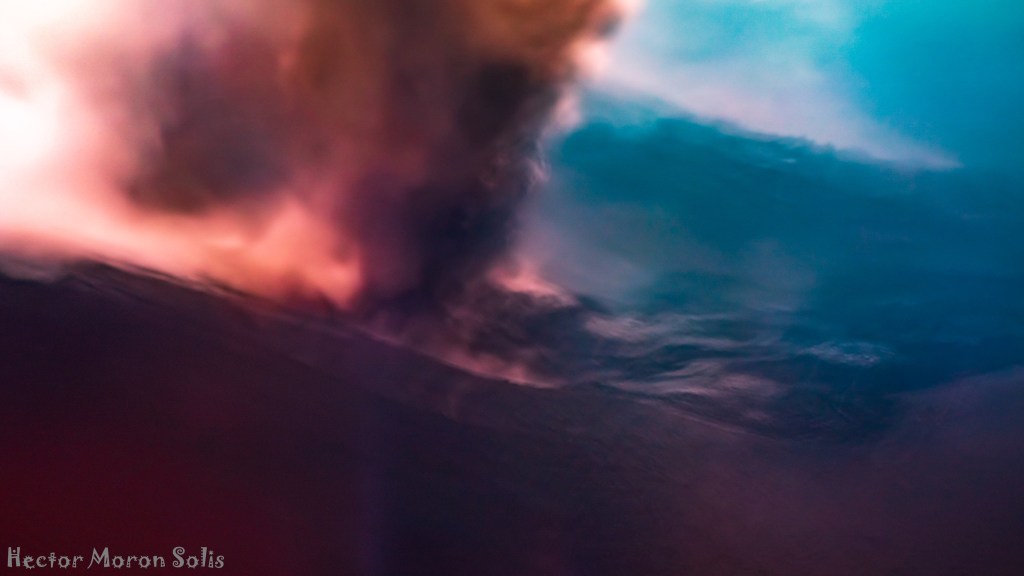
First Gases — The Breath of the Earth
The sequence begins with the first exhalation: gases escaping from the earth, carrying sparks of fire within them. In First Gases, the eruption reveals itself not with the fury of flowing lava, but with a breath — a convulsion of air, smoke and incandescent fragments. It is the planet’s first sigh, the signal that what has been concealed beneath layers of rock is ready to surface.
This instant is fragile and violent at once: a birth masked as an explosion. Allegorically, it is the awakening of a hidden heart, the first pulse of a force that has been gestating in silence. The gases veil and unveil, while the piroclasts announce the beginning of transformation. It is the threshold image of the series — the moment when the invisible interior becomes visible, when the earth first declares its intent to create and destroy.
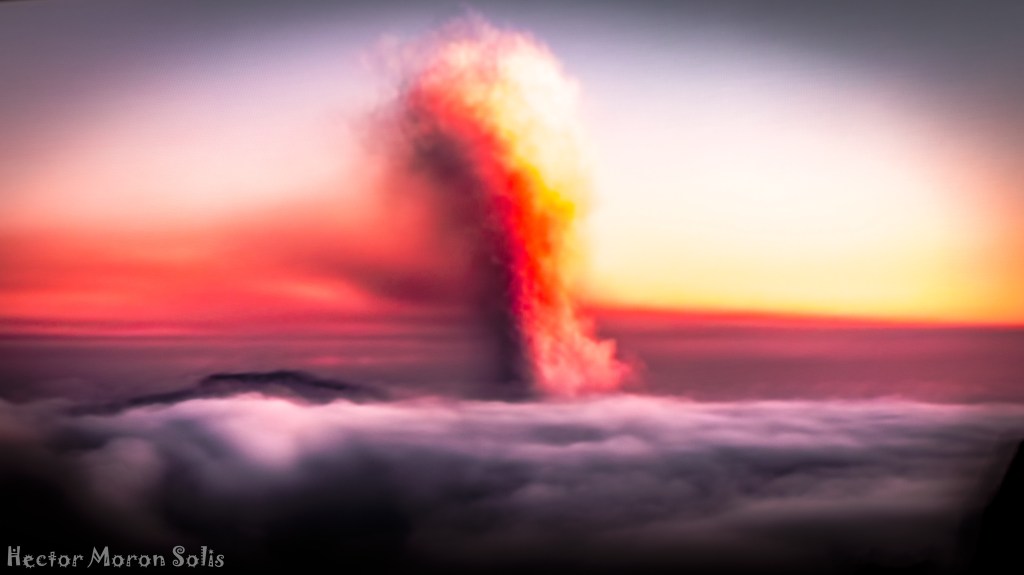
Interior of the Volcano — The Heart Revealed
After the first gases and sparks tore the surface, the volcano unveiled its innermost chamber. In Interior of the Volcano, the gaze penetrates the crater to glimpse the incandescent core — not yet a torrent, but a concentrated pulse of fire. The eruption here is less about destruction than revelation: a door momentarily opened into the hidden furnace of the earth.
Allegorically, this is the image of a heart revealed. What was buried deep, gestating in silence, now shows itself in its naked intensity. To look inside the volcano is to confront the paradox of power and vulnerability: the source of violence is also the place of origin, the core where energy is born. For an instant, the earth confesses its secret, exposing the living fire that sustains and threatens alike. It is the intimate face of catastrophe, a reminder that creation always begins within, where the invisible heart beats before the world can see it.
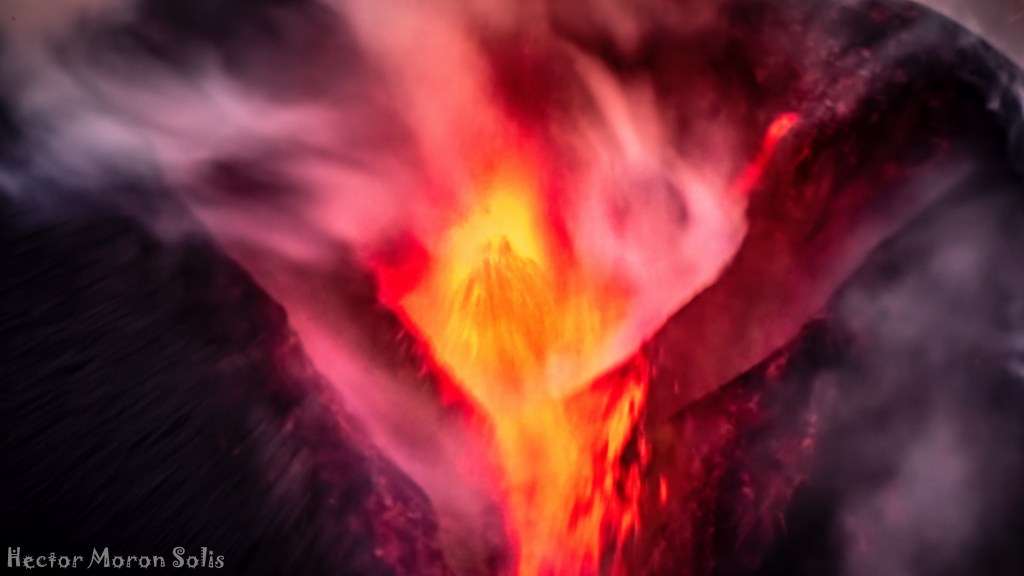
Lava I — The Torrent Unleashed
From the heart revealed, the eruption no longer contained itself. In Lava I, the force of the earth broke into motion, a river of molten rock descending with the inevitability of gravity. This was no longer a breath or a spark, but a torrent: the full body of fire made visible as it carved new lines across the land.
Allegorically, this image is the essence of unleashed energy, a vital current that destroys in order to transform. The lava moves like blood from the earth’s core, pulsing outward to write a new geography. It is the purest expression of the volcano’s will — unstoppable, radiant, terrifying, yet also fertile. In its incandescent flow lies the paradox of catastrophe: what annihilates is also what creates, what burns is also what seeds. Here, the volcano speaks in its most eloquent voice, and the world is forced to listen.

Lava II — The River of Fire
As the eruption advanced, the lava ceased to be a single torrent and began to spread, branching into channels that resembled a vast river basin. In Lava II, the land itself became a map of molten streams — a fiery network that echoed the courses of water, but written now in incandescent stone. It is as if the volcano, in its fury, tried to mimic the very element it would one day meet at the coast.
Allegorically, this image speaks of fire learning the language of water. The lava moves like a river, carving tributaries and merging currents, anticipating the ocean it has yet to touch. What we see is a rehearsal of union: the earth shaping fire into the form of flow, preparing it for its embrace with the sea. Destructive in its passage, yet prophetic in its shape, Lava II transforms catastrophe into a vision of convergence — the fiery memory of a river seeking its destiny.
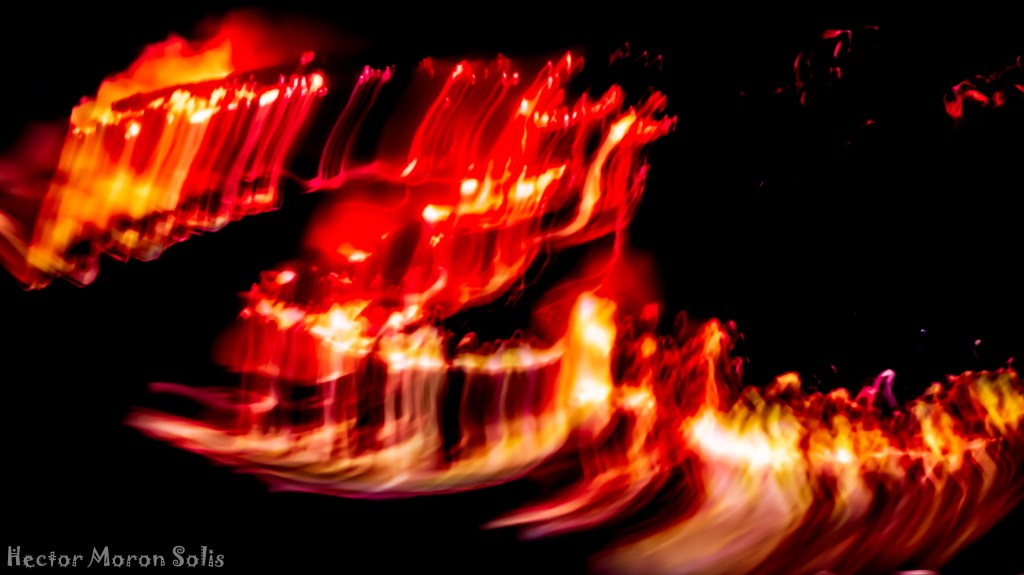
Lava Across the Land — Memory Erased
Between the torrent and the sea, the lava advanced across fields and villages, erasing houses, crops and roads. Though I chose not to photograph the human wound directly, this passage is part of the story. The land became both grave and canvas, a place where memory was consumed to prepare the birth of something new. The absence of images here is deliberate: what remains is silence, and the acknowledgment that destruction is inseparable from creation.
Lava Reaches the Sea — The Embrace of Opposites
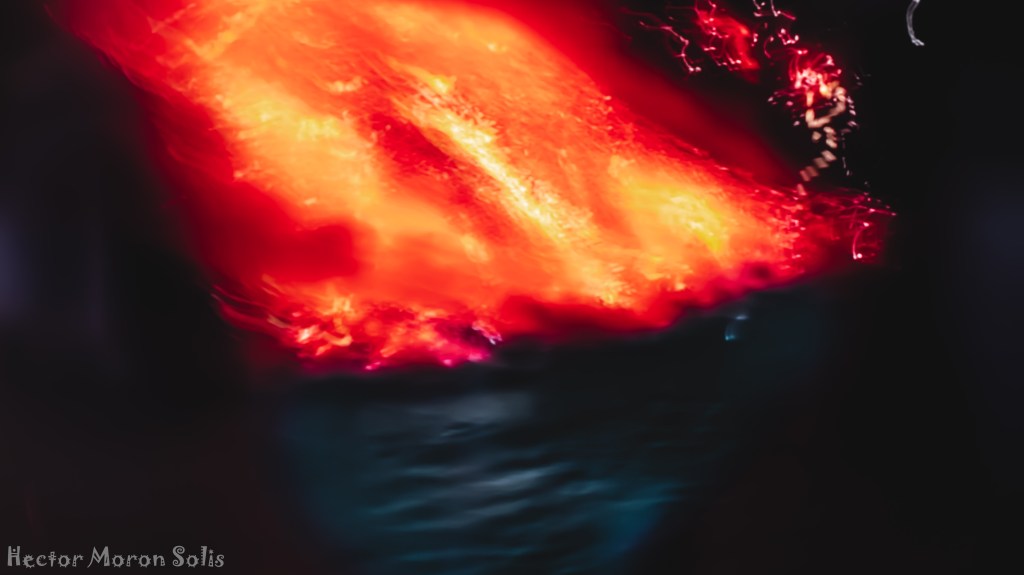
At last, the fire met the ocean. In Lava Reaches the Sea (Night), the incandescent torrents descended into darkness and were received by the vastness of water. What might appear as a violent clash revealed itself instead as an embrace: fire extinguished yet transformed, water wounded yet fertile. The sea, far from resisting, absorbed the lava, cooling it into new ground, a newborn fragment of earth rising from the union of two powers.
Allegorically, this image is the resolution of the entire sequence. The antagonists reveal themselves as complements: fire seeking water, water shaping fire. Their meeting is both catastrophe and genesis, an act where destruction becomes the seed of creation. In the night, the blaze does not end — it becomes soil, a foundation for life to return. The island breathes again, carrying within it the memory of that luminous embrace between elements.
Epilogue — New Creation
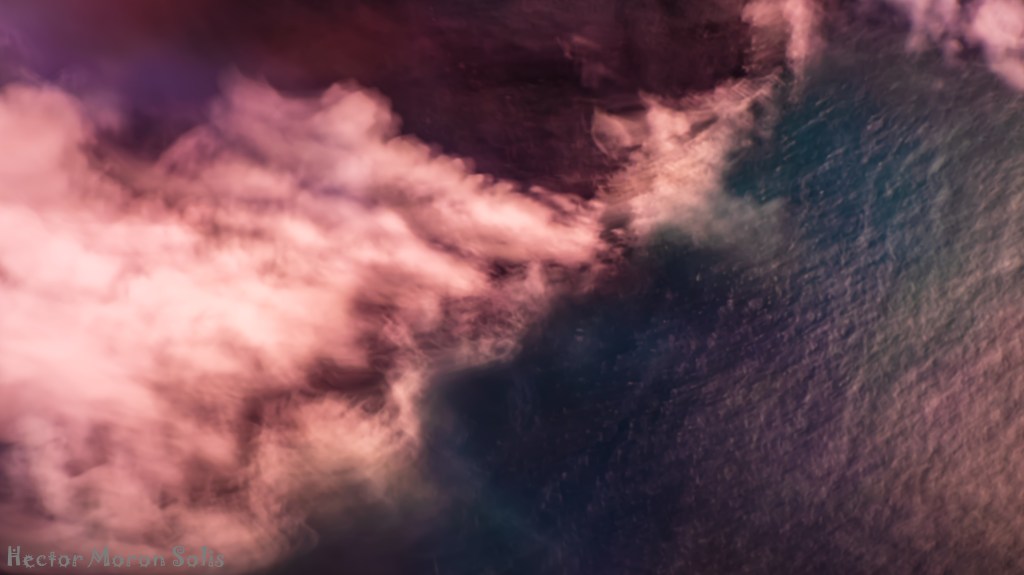
In the aftermath, silence returned to the island. The torrents subsided, the night cooled, and in the place of collision something new began to breathe. In this final image, the ocean shimmers in deep blue while the earth exhales its last vapors — gases rising not in violence, but in quiet testimony of transformation.
Here, fire and water no longer confront each other; they stand hand in hand. What was once annihilation becomes the ground for renewal. The sea tempers the fire, the fire solidifies within the sea, and together they compose an organic soil — fragile, raw, yet destined to host life.
Allegorically, this is the reconciliation of opposites, the union of elements long considered antagonistic. The volcano does not end in destruction, the ocean does not end in defeat: both transcend themselves to give birth to a new land. In this gesture, the island remembers that creation is always born of encounter, and that even from catastrophe can rise the quiet miracle of beginning again.

Leave a comment