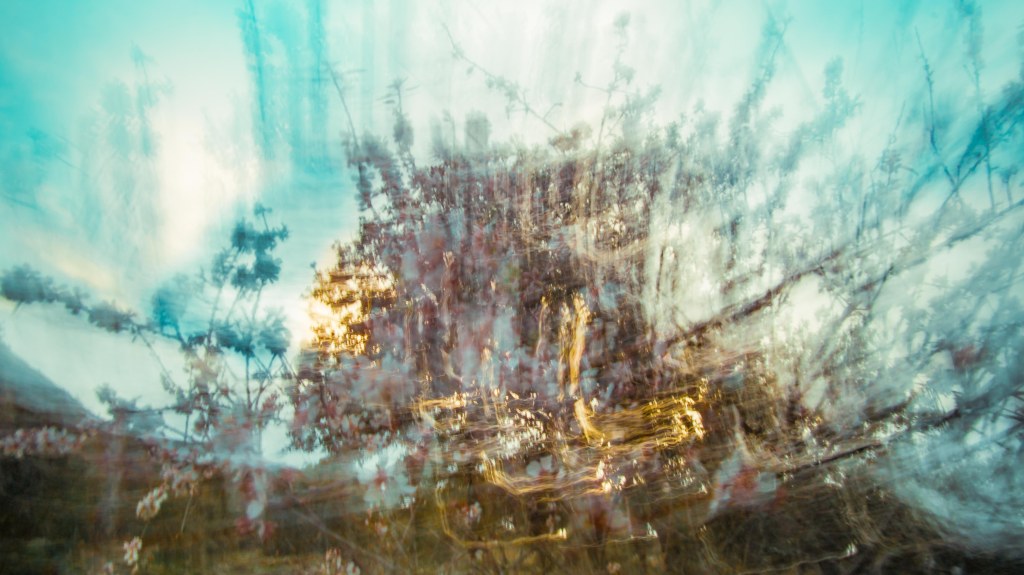
In recent years, Intentional Camera Movement (ICM) has evolved from an experimental resource into a widely recognized genre of fine art photography. Its language — based on long exposures (0,5s-1,5s) and controlled and speed gestures — has generated a new visual culture of abstraction and motion. Yet, as the technique matured, it also began to repeat itself: vertical sweeps, pictorial imitations, and a constant search for harmony. ICM became a discipline of its own, but also a formula — its rhythmic simplicity sometimes limiting its expressive range. From that repetition came the urge to move further: not only to move the camera, but to move through the world. It is from that boundary that Long-Exposure Travelling ICM emerged.
Traditional ICM techniques rely on relatively simple camera gestures that alter the scene while the photographer remains in place. Among the most common are the vertical or diagonal tilt, used to elongate trees or architectural structures; the horizontal pan, ideal for horizons, fields, or waves; the zoom burst, where the lens barrel is rotated during exposure to create the illusion of radiating light from a central point; and the swirl or full-camera spin, producing a vortex of circular motion around the frame. Each of these gestures transforms the surface of the image and can yield beautiful patterns of rhythm and blur, yet they remain confined to a single axis — the photographer does not move through space, only within it. The result is an image shaped by gesture, but not by journey

Conceived in 2019 and refined throughout 2020–2021, this method was born from the need to expand the photographic gesture beyond rotation or vibration. By employing ultra-wide focal lengths, ND1000 and CPL filters, and continuous forward movement lasting several seconds (6s-8s), the camera ceases to be static — it travels physically through the scene, almost like a dolly in cinema.
Allowing the body itself to choreograph light. Instead of a blur of shapes, the resulting image becomes a field of transformation — a record of displacement and encounter, where light, matter, and duration collide and fuse.
Traditional ICM, for all its beauty, rarely allows for narrative. It produces images of distinctive aesthetic allure, but most of the established canon remains focused on surface and mood. With Long-Exposure Travelling ICM, however, the photographer can move through more seconds as if becoming the camera itself — directing the gesture, choosing the trajectory, and deciding where the story unfolds. The exposure becomes not merely an act of depiction but an act of narration, where the body writes light into time. Unlike traditional ICM, the gesture is careful and long.
In Eden Tree I, the camera moves forward through layers of green and gold. The tree becomes both axis and vortex — the center of gravity in a world of flowing light. This movement transforms the symbolic tree into a living archetype of rebirth, grounding the technique in allegory rather than formalism.
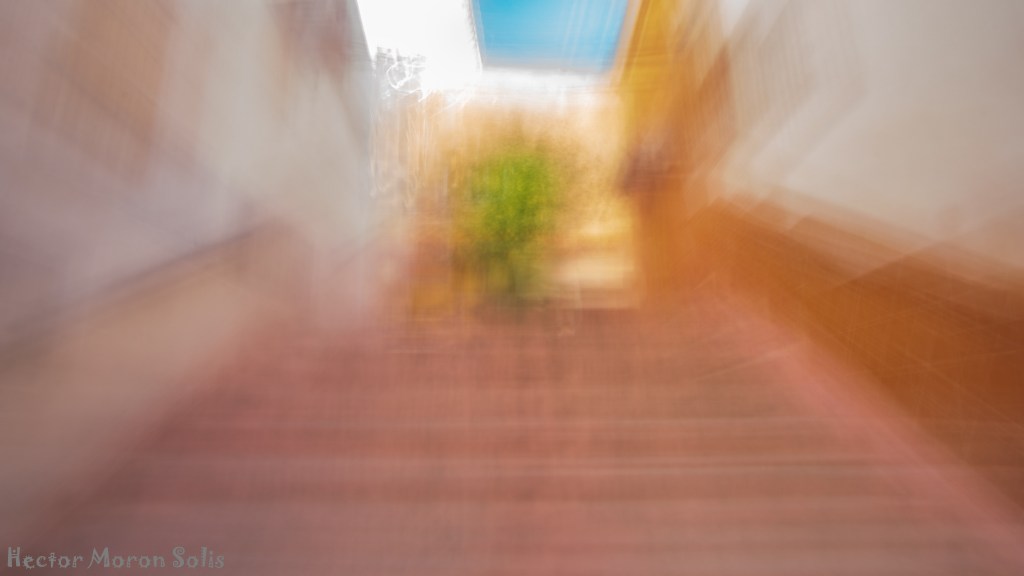
In Path to the Inner Light, the forward travelling is literal. The movement traces a luminous path that guides the viewer inward — toward the source of radiance within the image. What begins as a landscape becomes a metaphor for consciousness, a journey from perception to illumination.
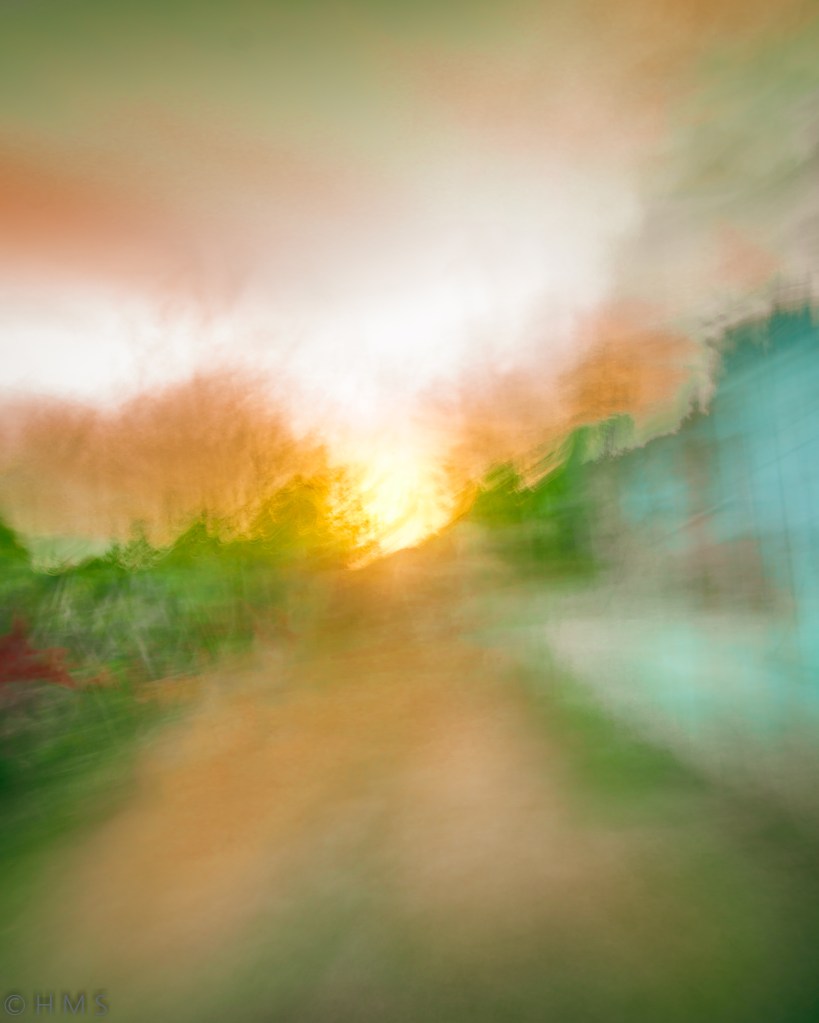
In this expanded exposure, the photograph becomes a trajectory rather than an instant. The motion is no longer a brushstroke over reality, but a passage through it. Each frame preserves the tension between chaos and control, creating an equilibrium where order arises from dissolution. The result feels alive, unstable, and temporal — the visual equivalent of breathing. Every line of light records the body’s path: the arc of an arm, the lean of the torso, the forward momentum of walking through space. Time accumulates like paint; the image becomes a choreography of energy.
In Hiker in the Surroundings of the Alhambra, the ancient walls of Granada dissolve under a cascade of light. The human figure becomes a fleeting rhythm within architectural memory. Through long motion, history and movement merge — the city breathes again, not as stone, but as vibration.
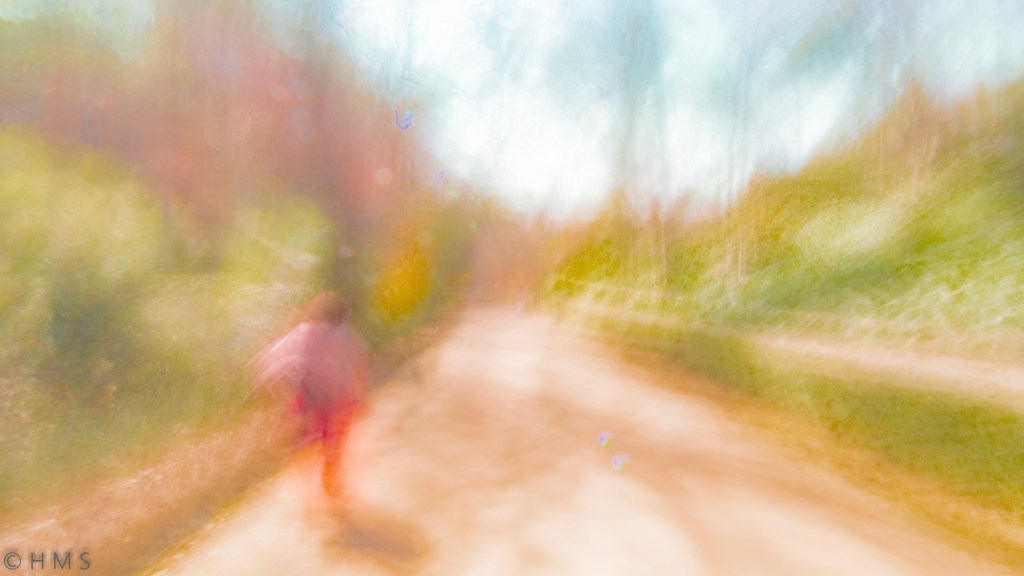
Aesthetically, this approach departs from the pictorial ICM tradition, which often seeks softness and harmony. Instead, Long-Exposure Travelling ICM embraces intensity, energy, and vertical depth. It captures not tranquility but vitality — the raw current of life, the pulse of existence itself. The photograph is not a dreamscape but a luminous trance. It evokes the feeling of crossing between states — day and night, form and abstraction, body and spirit. Every exposure becomes a ritual of light, where the act of seeing is inseparable from the act of moving.
Tsunami in Three Times condenses multiple moments of the sea into a single exposure. During the motion, the camera first points toward the foam — the most immediate energy, bright and chaotic — then ascends toward the rising wave, capturing its curved power, and finally moves outward toward the distant horizon where the water quiets into blue silence. This travelling of perspective transforms the photograph into a temporal sequence: from impact to ascent to release. The sea becomes a living metaphor of rhythm and persistence, where motion itself narrates the passage from turbulence to calm.
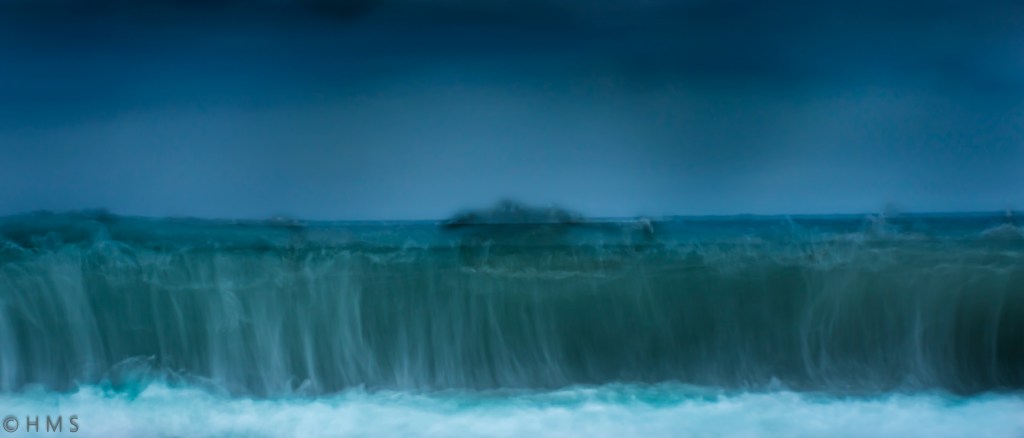
Conceptually, Long-Exposure Travelling ICM aligns with my broader movement, Allegorical Abstractionism. Each photograph becomes not a representation but a participation: the camera acts as both witness and actor, moving through landscapes — natural or human — and revealing their fragile coexistence. The technique embodies a philosophy: that creation is movement, and movement is consciousness. By traversing the scene, the photographer assumes a dual role — creator and interpreter, presence and absence. The gesture becomes a mirror of life itself: unstable, luminous, constantly evolving.
In Specters Chasing Lights, motion becomes spectral — a haunting ballet of silhouettes and energy trails. The long exposure allows light to echo, turning movement into apparition. It is an ICM of memory, where photography touches the immaterial
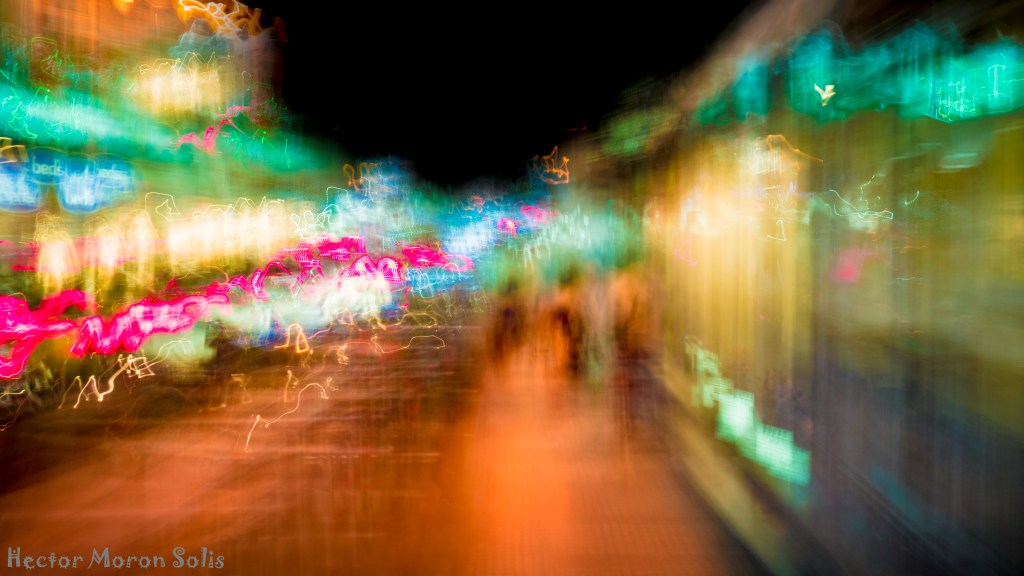
Ultimately, Long-Exposure Travelling ICM is not a variation but an expansion of photographic language. It transforms motion into narrative, and light into awareness. Where the traditional photograph captures an instant, this method captures a journey — a luminous trace of the passage between worlds. Through it, photography returns to its primal purpose: to translate the invisible forces that move us. Every long exposure becomes a meditation on distance, time, and transformation. This is not simply photography in motion; it is the motion of photography itself.
In The Sun Against the Human Walls, the confrontation between sunlight and architecture becomes allegorical: nature’s persistence against human rigidity. Through travelling movement, the sun seems to devour the walls — not as destruction, but as return. Light reclaims what form once tried to contain.


Leave a comment