Introduction
The Bell Tower of Loja Triptych emerges from a return to origin: the main church tower of Loja, the artist’s birthplace in southern Spain. In Andalusian culture —and throughout the Mediterranean— the bell tower is not simply a piece of architecture. It is an emotional landmark, a vertical axis that organizes collective life, and a symbolic marker binding the human world to the divine. For centuries, its rising geometry has governed time, ritual, and the spiritual imagination of the community.
Through the technique of Intentional Camera Movement (ICM), Héctor Morón does not depict the tower; he releases it from its physical form.
What remains is not stone, but vertical energy, a luminous current revealing the tower’s archetypal function: a hinge between two worlds, a ritual bridge joining earth and sky, human experience and transcendent aspiration.
The triptych unfolds across three symbolic dimensions:
1. The Divine
The first panel presents the tower as a pure ascending form — geometric, stable, almost idealized.
It embodies clarity, order, and the initial certainty of belief.
2. The Earthly
In the second image, the tower becomes denser and more tremulous.
Light washes over the structure, bending it into organic motion.
Here the architecture breathes: a human dimension where faith, doubt, time, and history converge.
3. The Threshold Between Worlds
In the third panel, the tower dissolves into a pulsating stream of golden and blue light.
It does not vanish; it transfigures.
The structure turns into an energetic phenomenon — the passage where the earthly ascends and the divine descends.
This is the tower’s ancient role restored: a vertical conduit of spiritual exchange.
Across the triptych, Loja’s most recognizable landmark transcends its local identity.
It becomes a vertical deity, a mythic presence that has regulated communal time and emotional life for generations. Through Morón’s gesture, the bell tower shifts from architecture to archetype — from local symbol to universal axis.
Origin, in this work, is not a place but a force: something that rises, vibrates, and finally burns at the threshold between worlds.
Technical Methodology – Allegorical Abstractionism in Motion
The work is created through Morón’s signature approach, rooted in Allegorical Abstractionism, a refined evolution of Intentional Camera Movement. Unlike conventional ICM, which often relies entirely on sweeping motion, the technique here intertwines:
• long moments of near-static exposure
(simulating the stillness and gravitational dominance of the Sun)
with
• elliptical micro-motions
(evoking the Earth’s rotation and orbital translation)
These subtle rotational arcs infuse the tower with a cosmological tension: the structure appears fixed and eternal, yet simultaneously in motion, as if animated by the invisible mechanics that govern celestial bodies. The result is a hybrid of stability and vibration — a visual metaphor for the human condition, suspended between the permanence of origin and the restlessness of existence. My method transform architecture into pure luminous behavior, turning the bell tower into an active spiritual organism rendered through movement, light, and time.

The opening image of the Bell Tower of Loja Triptych presents the world in its ideal state, a moment when heaven and earth still reflected one another with unbroken symmetry. Through a slow, nearly vertical gesture, the tower stretches upward into radiant bands of white and gold, rising as if carried by its own inner light. These colors are not merely aesthetic: white evokes revelation and spiritual clarity, while gold speaks of the eternal, the sacred fire of the sun, and the enduring presence of the divine.
Compositionally, the tower stands at the very center of the frame, functioning as an axis mundi — the universal vertical line that connects the human world below to the celestial world above. The structure gradually dissolves into a soft blaze of brightness, transforming from solid architecture into flowing luminosity. This transition from matter to light suggests that the tower is not simply a building, but a channel of ascension, a vertical conduit through which the sacred once moved freely.
Nothing in the scene is disturbed or fractured. The upward rhythm is steady and calm, almost liturgical in its serenity, as if the image were capturing the slow breathing of a world in perfect balance. In this first panel, the tower embodies the primordial moment before any rupture, before doubt, before the separation between realms. It stands as the ideal intermediary, a place where stone briefly becomes light and faith still touches the visible world.

In the second image, harmony begins to fracture. The tower, which in the first panel rose in pure white and gold, now burns in a palette of deep reds, ochres, and expanding shadows. This shift in color marks a decisive turn in the narrative: red becomes the symbol of rupture, of the human world overtaking the divine with desire, conflict, and the weight of history. The luminous ascent of the first panel is replaced by a downward pressure, as if the tower were no longer rising toward the heavens but struggling against them.
The structure appears heavier, thicker, more turbulent. The once-stable axis mundi now vibrates with uneven motion, its frame bending under the tension between light and darkness. The soft dissolution into brightness that characterized the first image is here replaced by a harsh combustion of tones, a visual metaphor for a world where clarity has dimmed and certainty has begun to collapse. Where the previous image held serenity and equilibrium, this one pulses with instability, signaling that the sacred order is no longer intact.
Light and shadow confront each other across the composition, creating a battlefield within the vertical form of the tower. The gesture of the camera introduces a subtle oscillation, a tremor that feels almost seismic, echoing the human condition: faith shaken, tradition challenged, and the spiritual center no longer able to hold itself upright without strain. The photograph captures the precise moment when imbalance emerges, when the beauty of the divine axis begins to break under the pressure of its own fire.
This panel stands in stark contrast to the first. It is no longer a vision of perfection but a portrait of a world entering turmoil, a world where the sacred no longer illuminates effortlessly but flickers, burns, and reflects the trembling of those who look up to it. If the first panel was the dawn of faith, this second panel is the dusk of certainty — the moment when the tower stops ascending and begins to fight against the forces that once sustained it.
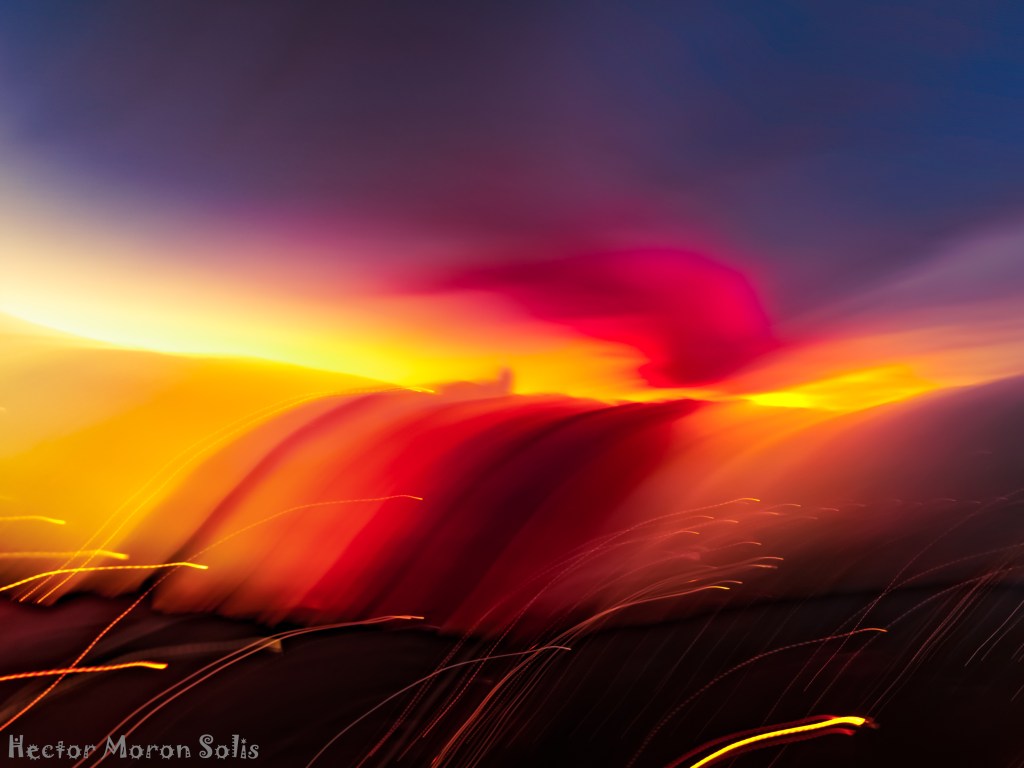
The final image unfolds as revelation. A sweeping wave of light —part divine eruption, part cosmic tide— engulfs the tower, dissolving its remaining structure into a surge of incandescent energy. The geometry that anchored the first panel and trembled in the second is now overtaken by a luminous force that expands across the frame with undeniable beauty. Gold, blue, and white fuse into a radiant storm, creating a chromatic horizon where matter seems to melt into pure presence. The color palette is crucial: gold becomes the fire of transcendence, blue the echo of the infinite, and white the moment of absolute clarity in which all forms surrender their weight.
The motion in this panel is broader and more fluid than in the previous two, as if the camera had followed the breath of a divine wind sweeping through the tower. Verticality gives way to curvature; the structure no longer stands but flows, transformed from architecture into movement, from stone into light. This transition marks the end of the earthly struggle depicted in the second panel. What was once resistance becomes release. The tower is no longer fighting gravity or shadow; it is being carried upward, absorbed into a larger celestial rhythm.
Here the sacred overtakes the human. The tower, symbol of faith and governance, is erased not in an act of destruction but in an act of transcendence. The divine wave does not shatter the tower — it reclaims it. The human imprint evaporates, leaving only the luminous essence that once animated the structure. This is the moment where the axis mundi completes its cycle: not rising from earth to heaven, but dissolving entirely into the origin of all illumination. The photograph reveals that the final truth of form is light, and the final fate of the sacred is radiance.
In this last panel, the world returns to its initial purity. After the harmony of the first image and the turmoil of the second, the third offers a resolution where conflict disappears and everything, once again, becomes light. What remains is the beauty of revelation, the serenity of dissolution, and the understanding that the divine does not fall with the human — it absorbs it, transforms it, and carries it back to the source where all creation begins.
Allegorical Abstractionism: Dehumanization Triptych
Encrypted Sun Cycle: Exploring the Seven Suns of Encrypted Divinity
