Chris Friel — Psychological Expressionism in ICM
Friel was a painter before he was a photographer, and that background is evident in his “eye”: he doesn’t capture scenes, but rather interprets them using the sensor as a canvas and camera movement as a brush to create images that evoke expressionist melancholy paintings. Unlike other ICM photographers who move the camera throughout the exposure, Friel employs a mixed technique of initial stillness to record recognizable forms followed by a final movement (often forward or rapid jerks) that creates an ethereal, enveloping trail. His color blindness (protanopia) was the catalyst that, around 2010, led him to abandon black and white and embrace a unique color palette focused on contrast, light, and emotional abstraction rather than chromatic fidelity. This shift solidified his rejection of complex post-processing, preferring compositional simplicity and the use of tilt-shift lenses to generate points of surgical sharpness amidst a sea of blur, thus capturing the impermanence of the moment directly in the camera.
“After” (Series and PhotoBook), is perhaps his most emotional and intimate series. It was created in 2016, shortly after his son Joe committed suicide. The images, many in black and white, were taken on the Isle of Harris and Lewis (Scotland), a place Joe loved. His themes explores grief, loss, and memory. Regarding aesthetics, the photographs are deeply melancholic, using ICM to evoke the fragility of memories and the feeling that things fade away. They feature vast landscapes with blurred or out-of-focus elements that reflect his emotional state. Chris Friel chose to display these images without frames or glass, mounted directly on the wall, for a more raw and immediate experience.
In “Hypergraphia”, Chris Friel shifts from landscape aesthetics to conceptual art and “claustro photography” as a coping mechanism, using his phone camera to record 150,000 moments in a methodological process. The work is seen as an exorcism of trauma rather than a pursuit of beauty, transforming a hospital room window into a threshold of hallucinatory visions. Friel’s titling, referencing a neurological writing compulsion, questions whether the creation is art or a symptom, resulting in a unsettling visual narrative employing serial repetition to explore extreme loneliness and self-disintegration.
Chris Friel’s “Pairs” series involves sophisticated editing that goes beyond single images to create a language of binary dialogues based on visual rhythm and tonal resonance. Friel pairs photographs from his archive, sometimes taken years apart, seeking organic continuity in textures, horizon lines, or ICM movement, creating diptychs that act as emotional mirrors. Within this series, the work titled “Wedding” stands out for its transition from natural landscapes to human presence; through his ICM technique, Friel deconstructs the figures into ethereal columns of light, stripping the social event of its anecdotal nature to focus on the geometry of movement. As a colorblind artist, these pairings—including the spectral whites of the wedding scene—rely on structural weight and contrast rather than chromatic fidelity, reminiscent of classical polyptychs. The resulting work demonstrates a relational minimalism where the emptiness of one shot balances the mass of another, prompting viewers to find the common essence uniting two seemingly unrelated moments into a single poetic entity.
Andrew S. Gray — The Architect of Motion
Andrew S. Gray’s work represents the most formalist and structural aspect of the Intentional Camera Movement, distancing itself from Friel’s melancholic expressionism to embrace a graphic and rhythmic abstraction. While Friel dissolves reality through his technique of stillness and shaking, Gray acts as a “stratifier” of the landscape, employing linear sweeps of constant speed—generally vertical in wooded environments—that transform organic matter into textures of almost textile purity. His mastery lies not in capturing chance, but in an extremely controlled geometry of movement that emphasizes chromatic saturation and compositional order, turning tree trunks and horizons into vibrant patterns that oscillate between contemporary design and chromatic minimalism. Based on his publications in On Landscape and his teaching work, it is confirmed that his methodology replaces Friel’s emotional “brushstroke” with absolute technical fluidity, where the use of stable supports and precise shutter speeds allows color and line to crystallize into an aesthetic of visual harmony, stripped of existential anguish to focus on the pure vibration of light.
In Ruins of St. Mary’s Abbey, York, Gray fuses architectural memory with motion, turning the medieval stone arches into trembling silhouettes that dissolve into the dusk light—an exemplar of his ability to make history flicker like breath. Arrival and the Land of the Cyclopes pushes this further into mythic abstraction: a shoreline rendered as a single sweeping diagonal, its colours compressed into a storm of ochres and steel blues, suggesting both the violence and the poetry of approaching land. In Loss Series: Faltering Under the Fury (2015), perhaps the most emotionally charged of the group, Gray uses dense lateral movement to fracture the horizon, creating a landscape that feels wounded yet luminous; the blur becomes metaphor, a rupture in light itself. Finally, Bamburgh Castle on an August Evening anchors the series in coastal drama—its fortress reduced to a ghostly glow above a molten sky, the long shutter transforming waves into a ribbon of soft fire. Together, these works articulate the foundations of Abstract Landscapes I: motion as architecture, colour as atmosphere, and landscape as a memory trembling into abstraction.
In Lanscapes II, Andrew S. Gray employs a “liquid” style where extreme post-processing transforms initial captures into images resembling 19th-century oil paintings. “Psychedelic Harbottle” uses vibrant, unreal colors and a vibrating movement to disintegrate stone, while “Lindisfarne” focuses on minimalism through smooth diagonal sweeps that merge sky and sand. “Dryburgh Abbey Study” reflects the influence of J.M.W. Turner, combining a brief static phase with upward movement and post-processing that accentuates golden tones.
Kaisa Sirén — Silence and Boreal Light
The discipline of Intentional Camera Movement finds its zenith in three distinct philosophical poles: the raw emotion of Chris Friel, the rhythmic geometry of Andrew S. Gray, and the meditative silence of Kaisa Sirén. While Friel uses the sensor as a canvas to interpret loss and memory through a “still-then-move” technique that shatters form into expressionist strokes, Gray acts as a formalist architect, employing fluid, linear sweeps to transform the landscape into a structured dialogue of light and vibrant color. Standing in contrast to both is Kaisa Sirén, the poet of the North, who transforms motion into an act of stillness. Working from the Finnish Lapland, her photography exists at the threshold of the invisible, where gesture is governed by the rhythm of a single inhalation. Her movement is the most restrained of the three, employing subtle displacements that capture the crystalline presence of the Arctic. Eschewing golden tones for a palette of whites, greys, and a profound spiritual blue, Sirén mirrors the cycle of the Kaamos polar night, proving that abstraction can lead to absolute serenity. Together, they demonstrate that ICM is not merely a technique of motion, but a journey from the visceral to the geometric, and finally, to the silence that remains after movement.
In the series “Dancing with Nature”, Kaisa Sirén trasubstantiates the Finnish forest and the vast Arctic landscapes of whites and spiritual blues into a ritualistic performance. This work transcends mere photography to become a pre-Christian spiritual ceremony, where her camera movement acts as a sacred choreography synchronizing the land with an ancestral pulse. The natural forms within her frames appear to dance in perfect synchronicity with the rhythm of the Aurora Borealis, evoking an animistic celebration where trees and light are no longer static objects, but living entities. By capturing this sacred liberation through rhythmic rotations and fluid gestures, Sirén reveals the ancient soul of the North, suggesting that the Arctic cycle is an eternal, divine dance between the earth and the heavens.
In the “Morning Thoughts” series, Kaisa Sirén achieves a profound visual synesthesia by translating the minimalist structures of composer Arvo Pärt into a language of light and introspection. This body of work represents a shift from spontaneous capture to a scripted, meditative process where each frame is a choreographed visualization of the thinking mind. The zenith of this series, “Like a road leading to the unknown”, acts as a spiritual bridge where ICM is stripped of all artifice to reveal a spiritual Arctic blue path flowing with liquid elegance. This trail guides the viewer toward a horizon where the coldness of the North meets a quasi-ethereal golden veil, a celestial threshold that represents the dawning of an idea. Through this transition from the crystalline blue shadows to the warm, infinite mystery of the golden glow, Sirén proves that the act of thinking is itself a journey—clear at its origin, yet dissolving into a divine and hopeful unknown.
Erik Malm — The Conductor of Light and Color
Among the masters of Pure ICM, Erik Malm stands as the scientist and maestro of motion, transforming intuition into a symphonic method of chromatic hyper-structure. Unlike the single “still-then-move” anchor used by Chris Friel, Malm employs a sophisticated “multiple stop-and-go” technique—a visual staccato executed throughout exposures of 0.5 to 8 seconds. By conducting the camera with a sequence of micro-pauses followed by rapid, rhythmic displacements, he allows the sensor to record the absolute purity of each pigment before jumping to the next. This disciplined “peining of light” prevents colors from contaminating each other, resulting in a liquid geometry characterized by a grain of luminous threads and concentric fibers. Drawing from his background as a solo clarinetist and his rigor in ergonomic research, Malm avoids the blurry mess of traditional motion to create a high-definition digital pointillism. In his hands, ICM becomes a polished, vibrant performance where light seems to emanate from carved crystals, proving that beauty emerges not from spontaneity, but from the perfect orchestration of vibration, exactness, and chromatic separation.
In his “Landscape Gallery”, Erik Malm reaches the pinnacle of tridimensional abstraction, achieving what art criticism defines as spatial stratification. Through his visual staccato and rapid micro-movements, Malm does not merely stretch color; he physically “sculpts” the depth of the image, clearly differentiating the proximal term (foreground), the middle plane, and the distal background. This unique ability to maintain the structural integrity of shrubs and hills while enveloping them in spectral vortices of light creates a dynamic sfumato: an atmospheric perspective built through chromatic vibration rather than traditional lines of flight. His compositions of parallel hills and defined bushes prove that his “multiple stop-and-go” method allows objects to retain their physical identity while rotational movements generate a ghostly energy around them. The result is a capillary resonance where each layer of the landscape breathes independently, defying the flatness of traditional ICM to offer a profound sense of sculpted space.
In the “Lighthouse Gallery”, Erik Malm applies his “visual staccato” technique to an environment of architectural rigidity and extreme directional light, where the lighthouse serves as a vertical axis of symmetry. Malm deconstructs the structure to explore the duality between the solidity of the stone and the immateriality of its flash. He uses micro-lateral movements to create a “tectonic vibration” effect on the lighthouse silhouette and employs spatial stratification to maintain sharpness at the base while dissolving the lantern into luminous threads . Through long exposures, the sea becomes a polished metallic surface and the sky appears as chromatic silks framing the lighthouse. The most striking aspect is how Malm photographs the light beam, transforming it into a solid light sculpture through ICM, generating spectral vortices. Malm maintains the integrity of the single shot, making the lighthouse the anchor in a world that fades. You can view the full gallery at Erik Malm’s website.
Doug Chinnery — The Abstract Expressionist
Within the ICM movement, Doug Chinnery stands as the definitive Abstract Expressionist, shifting the focus from the external landscape to the internal landscape of the soul. Much like Mark Rothko, he treats color not as a property of things, but as a vibrating, emotional entity. By stripping away the literal through fluid, handheld gestures, he creates color fields that exist in a state of lyrical dissolution. In his work, the subject is no longer the forest or the sea, but the resonance of light and the atmospheric depth of the “unseen.” He is the alchemist who proves that photography can achieve the same transcendental presence as a master’s canvas, turning the act of shooting into a meditative performance of pure, non-figurative art.
In the series “Dreams of Tuscany”, Doug Chinnery fully embraces his identity as the “Rothko of the Camera.” He strips the Italian landscape of its tourist clichés, reducing hills and cypress trees to vibrating fields of color. Through a masterful, fluid “legato” motion, he creates a visual atmosphere where earth and sky merge into a chromatic haze of siennas, ochres, and olive greens. The series is a study in atmospheric dissolution, where the solidity of the Tuscan land is transmuted into a dreamlike, translucent meditation, proving that for Chinnery, the landscape is merely a canvas for the expression of pure light and silence.
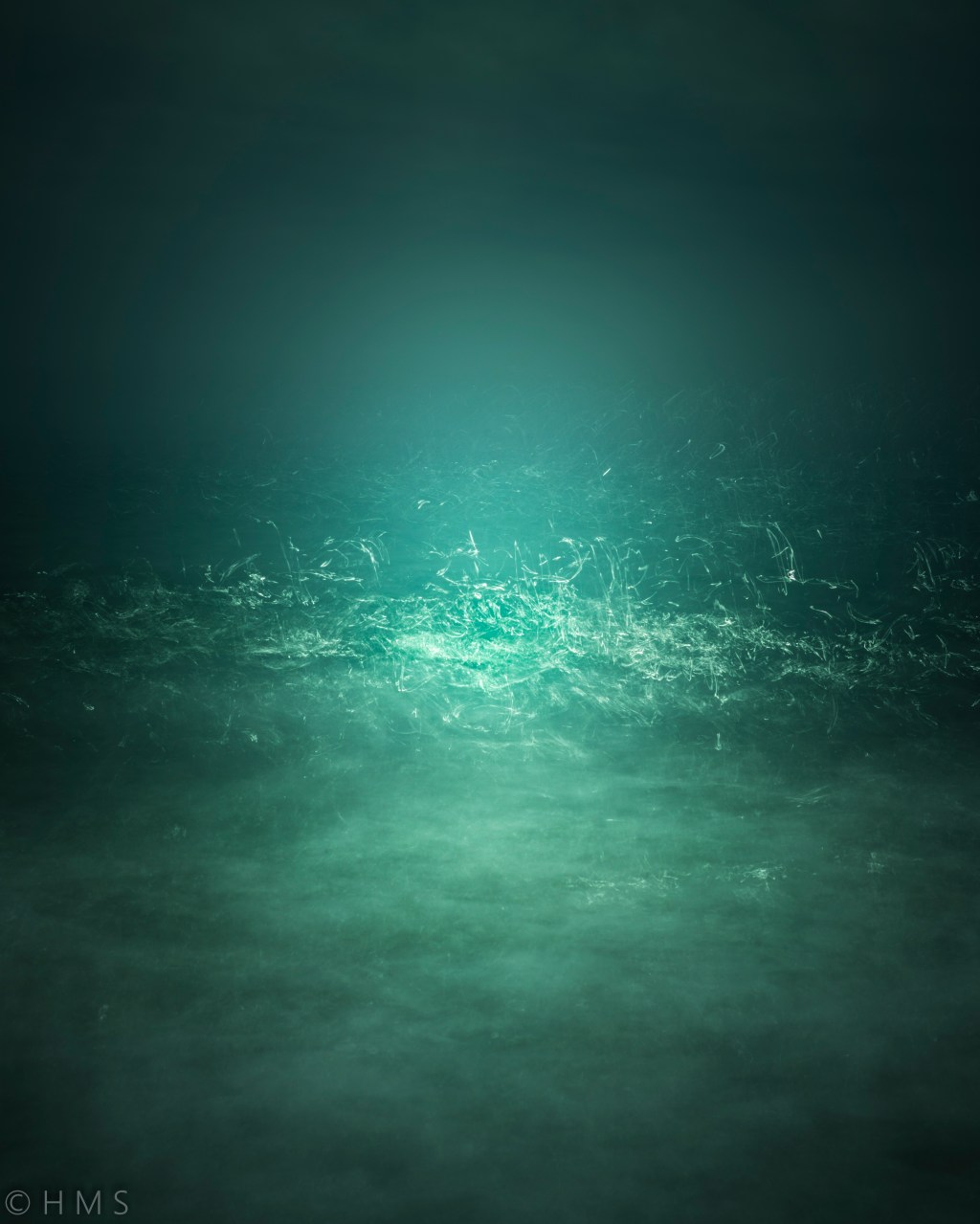
Doug Chinnery is the photographic heir to Mark Rothko, possessing the textural soul of a classical fresco painter. His work represents the ultimate shift toward pure abstraction, where form, color, and light merge into a coarse, organic surface. Unlike the “single-shot” purists, Chinnery embraces layered editing as a core creative pillar; he uses multiple exposures and textural overlays—often from rusted metals or aged plaster—to build a sense of physical weight. In series like “Dark Ocean”, he applies these layers with a painterly touch, using blending modes to let the light breathe through the “cracks” of the digital canvas. Frequently employing a square format ((1:1)), he strips the image of its geographic identity to focus on the vibration of color fields. In Chinnery’s hands, ICM is a process of visual alchemy, turning the solid world into a translucent, emotional, and tactile presence—occupying the sacred space where the landscape ends and the raw, physical resonance of light begins.

Leave a comment