
1. Introduction
2. The ICM as the True Abstract Photography
3. The Five Masters of Pure ICM Photography (2010–2025)
3.1 Chris Friel — Psychological Expressionism
3.2 Andrew S. Gray — The Architect of Motion
3.3 Kaisa Sirén — Silence and Boreal Light
1. Introduction
In the first decades of the twenty-first century, abstract photography has multiplied into a thousand directions. The medium, born to record reality, now seeks to dissolve it. Yet within that expansion, a paradox has emerged: the more photography speaks about abstraction, the less it remains photography. Galleries celebrate camera-less experiments and digital renderings, but what was once the art of light and time often turns into the art of data or chemistry. Against this dispersion, the Intentional Camera Movement (ICM) has remained the most human form of photographic abstraction — the last gesture where body, light, and world still coexist in the same act.
1.1 What ICM Is — and What It Is Not
ICM photography consists of deliberately moving the camera during a long exposure so that motion itself becomes the generator of form. It is not the accidental blur of failure but a choreography of gesture, where time stretches across the frame as light reacts to movement. Each exposure becomes an encounter between control and surrender. What defines ICM is not only technique but ontology: the photograph remains tied to the real world — to the light that was truly there — even as it transforms that world into abstraction.
By contrast, traditional long exposure, as practiced by artists like Alexey Titarenko, deals with stillness rather than movement. It keeps the camera fixed and allows time to flow across the stationary frame. The result is poetic, cinematic, even metaphysical, but it does not involve the act of physical motion. ICM begins where long exposure ends — when the hand intervenes and turns time into gesture. In this sense, ICM is not about waiting for the world to move; it is about moving through the world.
1.2 A Brief Genealogy
The gesture of moving the camera can be traced back to early experiments in pictorialism, to the restless dream of merging photography with painting. From the 1960s onward, several photographers — often unknowingly — began to explore motion within the frame: Ernst Haas with his impressionistic streets, Freeman Patterson with his color fields, and later Stephen Gill, who blurred urban life into fluid rhythm. Yet the ICM movement as an autonomous language truly emerged in the early 2000s, when digital cameras allowed continuous experimentation and immediate feedback. This was the decade when artists like Chris Friel, Andrew S. Gray, Erik Malm, Kaisa Sirén, and Doug Chinnery began to transform experiment into art.
Éric Petr, Long before the term Intentional Camera Movement was coined, He had already built the intellectual and aesthetic foundations of the discipline. Beginning in 1983, he pursued what he called in situ kinetic photography — a radical exploration of light as living matter, in which movement was not a mistake but a form of thought. Between 1983 and 1993, and later from 2003 onward, Petr developed a philosophy of photography that treated the camera’s gesture as an extension of consciousness itself: the act of moving with light rather than recording it. Series such as Bangkok 2004, Light Corpus and 光 0x1853AC (2020) reveal this search for a luminous essence where color, rhythm and perception merge into one continuum.
1.3 Purpose of This Essay
This essay is both homage and classification. It seeks to map the formation of the ICM language over the last fifteen years and to acknowledge those who defined its expressive grammar. These five artists — Friel, Gray, Sirén, Malm, and Chinnery — form what could be called the First Generation of Pure ICM Photography. Each represents a distinct path within a common field: emotion, geometry, silence, science, and transition. Their collective work not only shaped the discipline but gave it credibility in the wider landscape of abstract art. To study them is to study the birth of a new visual syntax — one that turns movement into meaning.
1.4 The Gesture — The Heart of the Medium
At the core of ICM lies the gesture: the physical act of moving the camera in dialogue with the subject. It can be vertical, horizontal, circular, or diagonal; sharp and brief, or fluid and continuous. The camera becomes an extension of the body, translating instinct into form. Each movement carries its own emotion: vertical gestures evoke ascension, horizontals convey calm or continuity, spirals suggest energy or confusion. In ICM, the hand does not simply hold the camera — it draws with it. The exposure becomes a trace of consciousness in motion, as if the photographer were sketching directly with light.
1.5 Two Poles — Northern Minimalism and Expressionism British
Over the past two decades, the ICM landscape has been defined by two true poles of influence. The Nordic school, shaped by Scandinavian light, embodies silence, minimalism, and restraint — a devotion to tonal purity and the reduction of gesture to its essential form. The British current, born from the grey skies of the Atlantic, translates introspection and emotion into movement, producing psychological landscapes that oscillate between melancholy and revelation. Between these two poles — the contemplative North and the expressive West — the contemporary ICM movement has evolved: a dialogue between stillness and turbulence, between meditation and feeling. Their coexistence has sustained the richness of the medium, allowing ICM to expand without losing its inner coherence.
1.6 Technology and Maturity
The maturity of ICM coincides with a technological turning point. The advent of mirrorless systems, electronic shutters, and neutral density filters has liberated the act of photographing from technical limitations. Long exposure of many minutes — once impossible without heavy tripods — can now be executed by hand. Precision sensors and stabilized optics have turned gesture into precision, allowing the photographer to compose within movement itself. The result is a paradoxical combination of spontaneity and control. Technology has not replaced the gesture; it has refined it. The contemporary ICM artist stands at the intersection of discipline and intuition — using modern tools to recover the primal act of painting with light.
In that convergence of gesture, philosophy, and innovation lies the essence of this movement. ICM is no longer a technical curiosity but a full artistic language — a way of thinking and feeling through motion. It is the last form of abstraction that remains genuinely photographic.
2. The ICM as the True Abstract Photography
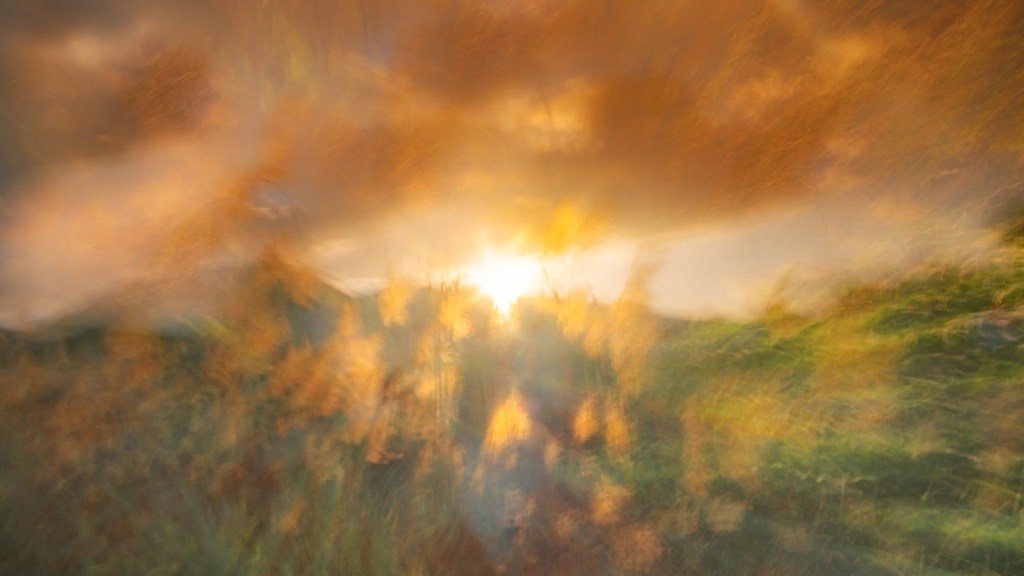
In the twenty-first century, abstract photography has expanded into multiple directions — chemical, digital, conceptual, algorithmic — yet the essence of the medium has gradually dissolved. The act of photographing, once defined by the encounter between human gesture and real light, is now often replaced by processes without cameras, sensors, or even the presence of a photographer. In that dispersion, the Intentional Camera Movement (ICM) has emerged as the only abstract practice that still preserves the fundamental triad of photography: camera, light, and world. Instead of erasing reality, it transforms it; instead of delegating vision to machines, it executes it with the body. ICM is not a denial of photography but its reawakening — the last frontier where abstraction and truth coexist.
2.1 The Four Contemporary Schools
Current photographic abstraction can be divided into four major lineages, each defined by its technical relationship to the real world.
1️⃣ The camera-less or pure school eliminates the camera altogether. It is the direct descendant of Man Ray and Moholy-Nagy, revived today by artists such as Wolfgang Tillmans, Ellen Carey, or Alison Rossiter. The image is born from physical reactions — light, heat, or chemistry — on the sensitive surface. The result is an ontology of light rather than a vision of the world. Its prestige is enormous — MoMA, Tate, Getty — yet its link to lived reality disappears: the image is not seen, it is generated.
2️⃣ The digital or algorithmic school transforms data into image. Thomas Ruff, Jessica Eaton, or Joan Fontcuberta operate at the border between information and representation. Their work is conceptually rigorous, often brilliant, but what appears as light is in fact computation. Time becomes code; the photographic act becomes programming.
3️⃣ The hybrid or pictorial-digital school merges photography, painting, and collage. Figures such as Valda Bailey, Adrian McGarry, or Doug Chinnery (in his later stage) use overlays, textures, and transparencies to create poetic compositions between media. The result is visually rich but ontologically unstable: photography dissolves into painting, the image into aesthetic object.
4️⃣ The ICM school, in contrast, keeps the camera and the encounter with the world. Its abstraction arises not from removing the real but from moving through it. The camera acts as a brush; time becomes matter; light becomes the raw material of transformation. Here, the gesture replaces the algorithm — motion as thought, duration as form.
2.2 The Institutional Elitism
The art system tends to value what moves away from photography more than what perfects it. Camera-less and digital artists usually come from academic backgrounds, fluent in the theoretical language that institutions expect — phenomenology, ontology of the image, materiality. Their discourse aligns naturally with the institutional vocabulary of curatorship — phenomenology, ontology, materiality — which has made their work easier to contextualize within museums and academic frameworks.. ICM photographers, on the other hand, have emerged from a self-taught lineage: individuals grounded in the act of seeing and feeling rather than theorizing. They speak through emotion, gesture, and light — elements that the institutional world still struggles to translate into academic legitimacy.
This linguistic gap has created an imbalance: what abandons photography is accepted as contemporary art, while what refines it remains labelled as decorative fine art. It is a paradox — the closer one stays to the medium’s essence, the further one is from recognition. Yet history shows that every artistic revolution began outside the canon. Impressionism, expressionism, surrealism — all were dismissed as minor, impulsive, or unrefined until time revealed their depth. ICM now stands at the same threshold. It is still underestimated by institutions precisely because it has not yet been theorized enough — because its truth is tactile, intuitive, and human. But that very resistance is its power: it reminds the contemporary image world that creation is not a concept but an act.
2.3 From Experiment to Language
For decades, camera movement was dismissed as error or curiosity — a by-product of technical failure. Early examples of ICM were playful, accidental, or purely aesthetic, producing blurs without discourse. At the beginning of the twenty-first century, however, a new generation turned that gesture into a language. Valda Bailey elevated the pictorial dimension of movement, creating harmony through colour and layering. Chris Friel transformed motion into emotional expression, inaugurating a new photographic expressionism. Erik Malm fused technical precision with chromatic lyricism; Doug Chinnery brought meditation and form; and Kaisa Sirén introduced the northern stillness — poetry through restraint.
With them, ICM evolved from experiment to discipline. What had been a random blur became a deliberate syntax of rhythm, composition, and emotion. The gesture acquired purpose: a way of thinking through light rather than depicting it. Today, the act of moving the camera is no longer an accident but a statement — a philosophical stance against photographic inertia. In the best works of this lineage, movement is not merely visual; it is conceptual. It embodies the passage of time, the persistence of perception, and the unity of emotion and matter. Through this transformation, ICM became a language capable of expression — a form of thinking through motion itself.
2.4 The ICM — The Last Frontier of the Human Act of Photographing
Unlike other schools that delegate creation to non-human processes — chemical or digital — ICM preserves the gesture. The photographer remains present, moving the camera, breathing with the light. Each trace is the mark of a body interpreting space: a physical and spiritual act. Camera-less art happens in the darkness of a lab; digital art within the silent logic of a server. In both, the creator disappears behind the process. ICM, by contrast, is corporeal: each image is the translation of a human movement. There is no automation; there is rhythm and pulse.
For this reason, ICM can be seen as the only abstract form of photography still connected to the human act of seeing. While artificial intelligence now generates endless simulations of vision, ICM reaffirms the value of the eye and the hand. Against automation, it stands as poetic resistance — proof that light still requires consciousness to find form. Every trace of motion becomes breath; every blur becomes memory. Its imperfection is its humanity. In this sense, ICM not only preserves the essence of photography but also its ethics: to look remains a human act. And in that affirmation — against the authorless image and the algorithmic perfection — lies its true greatness.
2.5 Bridge paragraph — Transition to Section 3
Through this convergence of body, light, and time, ICM has become not only a method but a philosophy — a way of recovering the human presence within the act of photographing. Yet no philosophy exists without its interpreters. Over the past fifteen years, a small group of artists has transformed this gesture into a language, each one shaping its own emotional, technical, and symbolic grammar. Together, they built what can be called the First Generation of Pure ICM Photography — the foundation upon which the movement now stands.
3. The Five Masters of Pure ICM Photography (2010–2025)
The contemporary language of ICM photography would not exist without a small group of pioneers who, each from their own vision, transformed an experimental technique into a complete artistic language. Between 2010 and 2025, these five photographers — Chris Friel, Andrew S. Gray, Kaisa Sirén, Erik Malm, and Doug Chinnery — established the grammar, emotion, and legitimacy of movement as a creative act. Together, they represent the founding generation of the ICM discipline: a bridge between the photographic past and the abstract future.
It is important to clarify that this essay does not include Valda Bailey among the five masters, despite her undeniable influence and visibility within the field of abstract photography. Bailey’s practice, though initially rooted in camera movement, gradually evolved into a hybrid language that combines multiple exposure, collage, and painterly construction. In this evolution, ICM became one element among others — a tool within a pictorial system rather than an autonomous gesture. The present essay focuses exclusively on those artists who defined ICM as a self-sufficient photographic language, grounded in gesture, light, and duration. Bailey’s contribution remains significant, but her later trajectory belongs to a different paradigm: the fusion of photography and painting rather than the pursuit of movement as pure form.
3.1 Chris Friel — Psychological Expressionism
Friel was a painter before he was a photographer, and that background is evident in his “eye”: he doesn’t capture scenes, but rather interprets them using the sensor as a canvas and camera movement as a brush to create images that evoke expressionist melancholy paintings. Unlike other ICM photographers who move the camera throughout the exposure, Friel employs a mixed technique of initial stillness to record recognizable forms followed by a final movement (often forward or rapid jerks) that creates an ethereal, enveloping trail. His color blindness (protanopia) was the catalyst that, around 2010, led him to abandon black and white and embrace a unique color palette focused on contrast, light, and emotional abstraction rather than chromatic fidelity. This shift solidified his rejection of complex post-processing, preferring compositional simplicity and the use of tilt-shift lenses to generate points of surgical sharpness amidst a sea of blur, thus capturing the impermanence of the moment directly in the camera.
After
“After” (Series and PhotoBook), is perhaps his most emotional and intimate series. It was created in 2016, shortly after his son Joe committed suicide. The images, many in black and white, were taken on the Isle of Harris and Lewis (Scotland), a place Joe loved. His themes explores grief, loss, and memory. Regarding aesthetics, the photographs are deeply melancholic, using ICM to evoke the fragility of memories and the feeling that things fade away. They feature vast landscapes with blurred or out-of-focus elements that reflect his emotional state. Chris Friel chose to display these images without frames or glass, mounted directly on the wall, for a more raw and immediate experience.
Hypergraphia
In “Hypergraphia”, Chris Friel shifts from landscape aesthetics to conceptual art and “claustro photography” as a coping mechanism, using his phone camera to record 150,000 moments in a methodological process. The work is seen as an exorcism of trauma rather than a pursuit of beauty, transforming a hospital room window into a threshold of hallucinatory visions. Friel’s titling, referencing a neurological writing compulsion, questions whether the creation is art or a symptom, resulting in a unsettling visual narrative employing serial repetition to explore extreme loneliness and self-disintegration.
Pairs
Chris Friel’s “Pairs” series involves sophisticated editing that goes beyond single images to create a language of binary dialogues based on visual rhythm and tonal resonance. Friel pairs photographs from his archive, sometimes taken years apart, seeking organic continuity in textures, horizon lines, or ICM movement, creating diptychs that act as emotional mirrors. Within this series, the work titled “Wedding” stands out for its transition from natural landscapes to human presence; through his ICM technique, Friel deconstructs the figures into ethereal columns of light, stripping the social event of its anecdotal nature to focus on the geometry of movement. As a colorblind artist, these pairings—including the spectral whites of the wedding scene—rely on structural weight and contrast rather than chromatic fidelity, reminiscent of classical polyptychs. The resulting work demonstrates a relational minimalism where the emptiness of one shot balances the mass of another, prompting viewers to find the common essence uniting two seemingly unrelated moments into a single poetic entity.
Singles (Curated Highlights)
The Singles collection, though not a “series” in the traditional sense, functions as a curated retrospective of Friel’s strongest independent works — each image a distilled statement of his visual philosophy. Image #1, a spectral horse floating in black void, embodies his ability to transform motion into apparition; Image #2, an almost abstract portrait where the face is smeared into vertical streaks, showcases his command of emotional erasure; Image #3, a forest rendered as glittering pointillism, shows how he pushes low-light ICM into the realm of painting. Technically, these works mix short and long shutter speeds, lateral and rotational movements, and an extremely intuitive sense of tone. Conceptually, Singles is the clearest demonstration of Friel’s core identity: a photographer who paints with disappearance.
3.2 Andrew S. Gray — The Architect of Motion
Andrew S. Gray’s work represents the most formalist and structural aspect of the Intentional Camera Movement, distancing itself from Friel’s melancholic expressionism to embrace a graphic and rhythmic abstraction. While Friel dissolves reality through his technique of stillness and shaking, Gray acts as a “stratifier” of the landscape, employing linear sweeps of constant speed—generally vertical in wooded environments—that transform organic matter into textures of almost textile purity. His mastery lies not in capturing chance, but in an extremely controlled geometry of movement that emphasizes chromatic saturation and compositional order, turning tree trunks and horizons into vibrant patterns that oscillate between contemporary design and chromatic minimalism. Based on his publications in On Landscape and his teaching work, it is confirmed that his methodology replaces Friel’s emotional “brushstroke” with absolute technical fluidity, where the use of stable supports and precise shutter speeds allows color and line to crystallize into an aesthetic of visual harmony, stripped of existential anguish to focus on the pure vibration of light.
Abstract Landscapes — Part I
In Ruins of St. Mary’s Abbey, York, Gray fuses architectural memory with motion, turning the medieval stone arches into trembling silhouettes that dissolve into the dusk light—an exemplar of his ability to make history flicker like breath. Arrival and the Land of the Cyclopes pushes this further into mythic abstraction: a shoreline rendered as a single sweeping diagonal, its colours compressed into a storm of ochres and steel blues, suggesting both the violence and the poetry of approaching land. In Loss Series: Faltering Under the Fury (2015), perhaps the most emotionally charged of the group, Gray uses dense lateral movement to fracture the horizon, creating a landscape that feels wounded yet luminous; the blur becomes metaphor, a rupture in light itself. Finally, Bamburgh Castle on an August Evening anchors the series in coastal drama—its fortress reduced to a ghostly glow above a molten sky, the long shutter transforming waves into a ribbon of soft fire. Together, these works articulate the foundations of Abstract Landscapes I: motion as architecture, colour as atmosphere, and landscape as a memory trembling into abstraction.
Abstract Landscapes — Part II
In Lanscapes II, Andrew S. Gray employs a “liquid” style where extreme post-processing transforms initial captures into images resembling 19th-century oil paintings. “Psychedelic Harbottle” uses vibrant, unreal colors and a vibrating movement to disintegrate stone, while “Lindisfarne” focuses on minimalism through smooth diagonal sweeps that merge sky and sand. “Dryburgh Abbey Study” reflects the influence of J.M.W. Turner, combining a brief static phase with upward movement and post-processing that accentuates golden tones.
Abstract Landscapes — Part III
In Standing Stones, Gray turns ancient monoliths into flickering sentinels—the long exposure softens their mass into trembling silhouettes, as if history itself were vibrating beneath the sky; the motion is restrained, a slow lateral drift that preserves the stones’ dignity while dissolving their edges into myth. Solstice expands this atmospheric quietude into something cosmic: warm golds and cold blues slide across the frame in a single suspended gesture, the landscape reduced to pure luminance, a meditation on seasonal light rather than geography. With Quirang, Gray confronts one of Scotland’s most dramatic terrains and renders it nearly abstract—its jagged escarpments melt into vertical veils of green and grey, turning raw geology into a painterly cascade that feels more like memory than observation. Finally, The Great Whale pushes his poetic minimalism to its limit: a vast pale sweep, almost empty, where a single soft curvature evokes the back of a breaching creature beneath a sky of muted silver. Together these works define Abstract Landscapes III as Gray’s most introspective and atmospheric phase—where landscapes become breath, stone becomes apparition, and motion becomes a language of quiet revelation.
Abstract Landscapes — Part IV
Abstract Landscapes IV marks the moment where Gray moves from atmospheric restraint into a more luminous, emotionally open phase: colours become fuller, exposures slightly wider, and the ICM gesture slow enough to stretch light without fracturing form. The landscapes here are no longer dissolved memories (como en la III) but rather sustained emotions, almost chromatic meditations, where each sweep contains a distinct emotional intention. New Dawn, Old Scene (2021) is the manifesto of this maturity: a golden field of diffused light where movement transforms the morning into a warm sigh; the scene is not new, but the emotion is—a rebirth on the same horizon. Home Evenings captures the opposite tone: soft blues and warm browns shifted laterally, the long gesture that transforms a domestic afternoon into something intimate and fragile, a landscape that breathes as if it were a personal memory. Pier Light introduces structure: precise horizontals that support an orange glow vibrating in the center of the painting, an almost musical balance between architectural form and chromatic dissolution, one of his most “drawn” pieces within the movement. And Ruins by Moonlight – Warkworth Castle demonstrates his total technical control: deep shadows, a translucent arc of light, and minimal movement that envelops the ruins in a spectral halo without losing their character; it is nocturnal poetry created with discipline. Overall, Abstract Landscapes IV is his most mature and complete phase: color without exuberance, structure without rigidity, emotion without excess—the final synthesis of everything he has learned throughout his career.
3.3 Kaisa Sirén — Silence and Boreal Light
The discipline of Intentional Camera Movement finds its zenith in three distinct philosophical poles: the raw emotion of Chris Friel, the rhythmic geometry of Andrew S. Gray, and the meditative silence of Kaisa Sirén. While Friel uses the sensor as a canvas to interpret loss and memory through a “still-then-move” technique that shatters form into expressionist strokes, Gray acts as a formalist architect, employing fluid, linear sweeps to transform the landscape into a structured dialogue of light and vibrant color. Standing in contrast to both is Kaisa Sirén, the poet of the North, who transforms motion into an act of stillness. Working from the Finnish Lapland, her photography exists at the threshold of the invisible, where gesture is governed by the rhythm of a single inhalation. Her movement is the most restrained of the three, employing subtle displacements that capture the crystalline presence of the Arctic. Eschewing golden tones for a palette of whites, greys, and a profound spiritual blue, Sirén mirrors the cycle of the Kaamos polar night, proving that abstraction can lead to absolute serenity. Together, they demonstrate that ICM is not merely a technique of motion, but a journey from the visceral to the geometric, and finally, to the silence that remains after movement.
Dancinc my Nature
In the series “Dancing with Nature”, Kaisa Sirén trasubstantiates the Finnish forest and the vast Arctic landscapes of whites and spiritual blues into a ritualistic performance. This work transcends mere photography to become a pre-Christian spiritual ceremony, where her camera movement acts as a sacred choreography synchronizing the land with an ancestral pulse. The natural forms within her frames appear to dance in perfect synchronicity with the rhythm of the Aurora Borealis, evoking an animistic celebration where trees and light are no longer static objects, but living entities. By capturing this sacred liberation through rhythmic rotations and fluid gestures, Sirén reveals the ancient soul of the North, suggesting that the Arctic cycle is an eternal, divine dance between the earth and the heavens.
Morning Thoughts
In the “Morning Thoughts” series, Kaisa Sirén achieves a profound visual synesthesia by translating the minimalist structures of composer Arvo Pärt into a language of light and introspection. This body of work represents a shift from spontaneous capture to a scripted, meditative process where each frame is a choreographed visualization of the thinking mind. The zenith of this series, “Like a road leading to the unknown”, acts as a spiritual bridge where ICM is stripped of all artifice to reveal a spiritual Arctic blue path flowing with liquid elegance. This trail guides the viewer toward a horizon where the coldness of the North meets a quasi-ethereal golden veil, a celestial threshold that represents the dawning of an idea. Through this transition from the crystalline blue shadows to the warm, infinite mystery of the golden glow, Sirén proves that the act of thinking is itself a journey—clear at its origin, yet dissolving into a divine and hopeful unknown.
Story of the Trees
“Story of the Trees” is Sirén’s most textural and rhythmic forest series, where repeated vertical sweeps carve the trunks into vibrating strands of color. Unlike her minimalistic pieces, these images are dense, tactile, and almost musical. The palette—purples, ochres, soft greens—creates a layered emotional complexity, halfway between serenity and tension. Technically, Sirén uses mid-length exposures (0.7–1.5 seconds) combined with a steady vertical drift, giving the illusion of woven fabric or rain falling through memory. Conceptually, the series feels like an intimate conversation with the forest: trees are not objects but voices, retold through movement. It is one of her most influential ensembles among ICM practitioners.
Speechless Sea
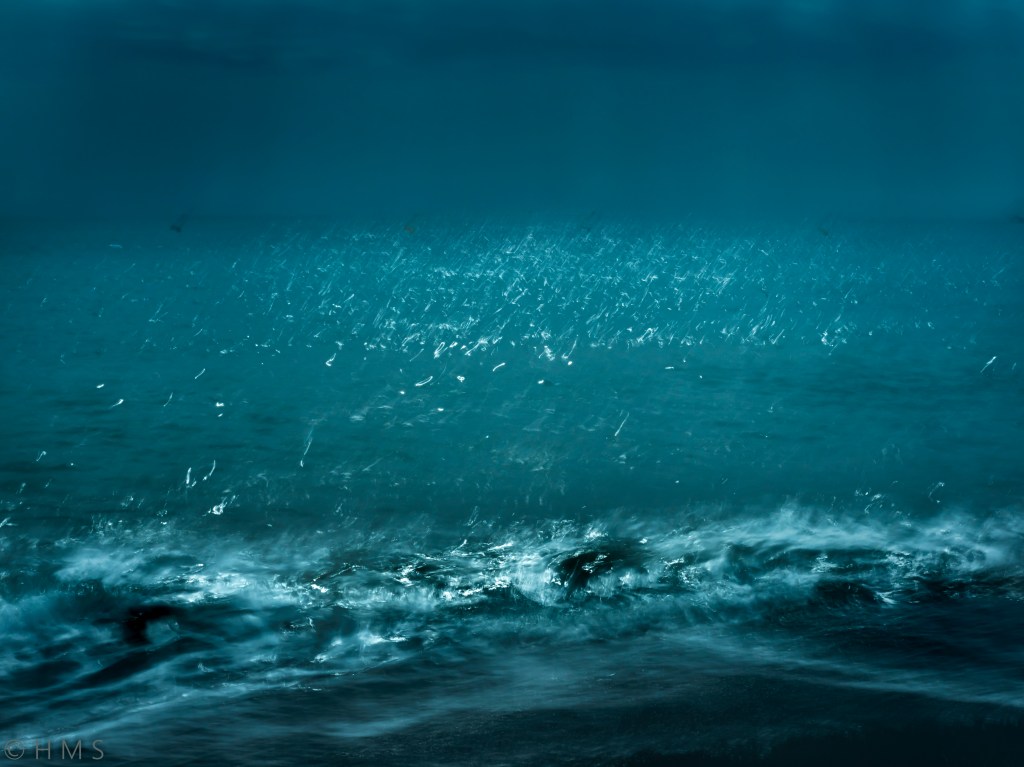
“Speechless Sea” distills Sirén’s fascination with boundaries—horizons dissolve into gradients that make sky and water indistinguishable. The motion is gentle but decisive, often horizontal, elongating blues and soft whites into dreamlike bands. Emotionally, the series is meditative, evoking silence, distance, and the feeling of standing alone before an infinite surface. Technically, Sirén’s exposures in this series are extremely clean: minimal noise, perfectly controlled blur, and tonal transitions that feel almost digital in smoothness despite being pure ICM. Conceptually, “Speechless Sea” expresses the loss of edges—where the world becomes continuous, fluid, and contemplative. It may be her most timeless and universal series.
3.4 Erik Malm — The Conductor of Light and Color
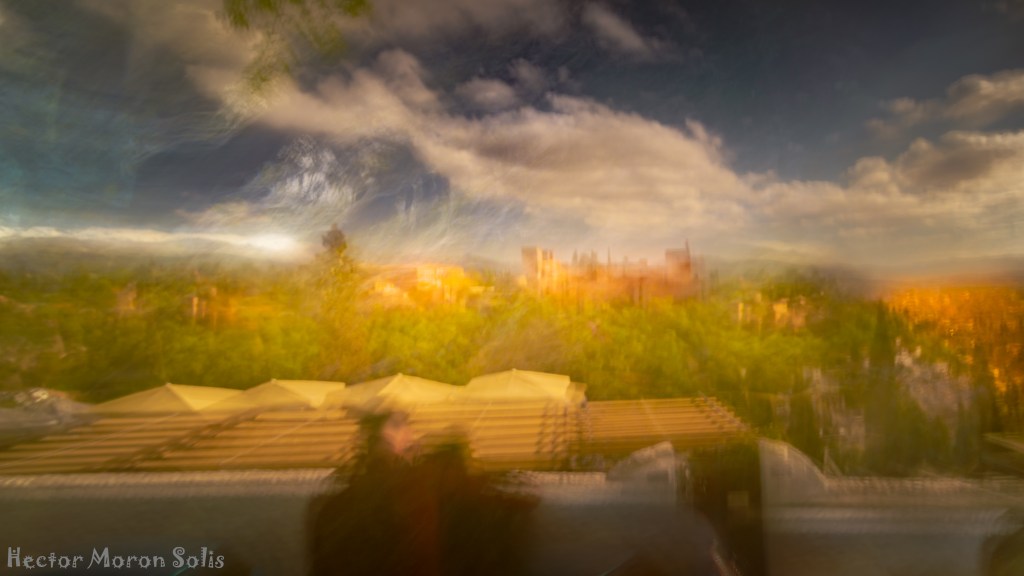
Among the masters of Pure ICM, Erik Malm stands as the scientist and maestro of motion, transforming intuition into a symphonic method of chromatic hyper-structure. Unlike the single “still-then-move” anchor used by Chris Friel, Malm employs a sophisticated “multiple stop-and-go” technique—a visual staccato executed throughout exposures of 0.5 to 8 seconds. By conducting the camera with a sequence of micro-pauses followed by rapid, rhythmic displacements, he allows the sensor to record the absolute purity of each pigment before jumping to the next. This disciplined “peining of light” prevents colors from contaminating each other, resulting in a liquid geometry characterized by a grain of luminous threads and concentric fibers. Drawing from his background as a solo clarinetist and his rigor in ergonomic research, Malm avoids the blurry mess of traditional motion to create a high-definition digital pointillism. In his hands, ICM becomes a polished, vibrant performance where light seems to emanate from carved crystals, proving that beauty emerges not from spontaneity, but from the perfect orchestration of vibration, exactness, and chromatic separation.
Landscape Gallery
In his “Landscape Gallery”, Erik Malm reaches the pinnacle of tridimensional abstraction, achieving what art criticism defines as spatial stratification. Through his visual staccato and rapid micro-movements, Malm does not merely stretch color; he physically “sculpts” the depth of the image, clearly differentiating the proximal term (foreground), the middle plane, and the distal background. This unique ability to maintain the structural integrity of shrubs and hills while enveloping them in spectral vortices of light creates a dynamic sfumato: an atmospheric perspective built through chromatic vibration rather than traditional lines of flight. His compositions of parallel hills and defined bushes prove that his “multiple stop-and-go” method allows objects to retain their physical identity while rotational movements generate a ghostly energy around them. The result is a capillary resonance where each layer of the landscape breathes independently, defying the flatness of traditional ICM to offer a profound sense of sculpted space.
Animal Collection
The Animal Collection is Malm’s most experimental and risk-heavy body of work: animals are transformed into flowing masses of motion, where biology dissolves into energy. His technique is unusually bold—ICM while tracking fast-moving subjects—resulting in silhouettes that hover between recognition and abstraction. The palette tends toward earthy neutrals and muted blues, reflecting natural environments rather than the vibrant chromatic overlays of his landscapes. Technically, this collection demonstrates mastery over instability: panning motions combined with subtle roll or tilt, executed at shutter speeds longer than traditional wildlife photography allows. Conceptually, the collection explores the tension between presence and disappearance, turning wildlife into symbols of fragility and transience. Though less iconic than his landscapes, these works show his range and technical audacity.
Lighthouse Gallery
In the “Lighthouse Gallery”, Erik Malm applies his “visual staccato” technique to an environment of architectural rigidity and extreme directional light, where the lighthouse serves as a vertical axis of symmetry. Malm deconstructs the structure to explore the duality between the solidity of the stone and the immateriality of its flash. He uses micro-lateral movements to create a “tectonic vibration” effect on the lighthouse silhouette and employs spatial stratification to maintain sharpness at the base while dissolving the lantern into luminous threads . Through long exposures, the sea becomes a polished metallic surface and the sky appears as chromatic silks framing the lighthouse. The most striking aspect is how Malm photographs the light beam, transforming it into a solid light sculpture through ICM, generating spectral vortices. Malm maintains the integrity of the single shot, making the lighthouse the anchor in a world that fades. You can view the full gallery at Erik Malm’s website.
Bird Collection
The Bird Collection is Malm’s lyrical counterpart to his more structured landscapes. Here, ICM traces the movement of wings, turning flight into gesture. Some works lean toward figurative silhouettes; others dissolve birds entirely into flickering strokes of white or color. Technically, these images require exquisite timing: shutter speeds often between 1/10 and 1 second, combined with precise tracking that transforms flapping motion into calligraphic marks. Emotionally, the collection speaks of freedom, fragility, and impermanence—birds rendered as the pure trace of their passage through air. Although not as chromatically complex as his Landscapes, this body of work showcases Malm’s sensitivity to temporal rhythm and his ability to transform speed into poetry.
3.5 Doug Chinnery — The Abstract Expressionist
Within the ICM movement, Doug Chinnery stands as the definitive Abstract Expressionist, shifting the focus from the external landscape to the internal landscape of the soul. Much like Mark Rothko, he treats color not as a property of things, but as a vibrating, emotional entity. By stripping away the literal through fluid, handheld gestures, he creates color fields that exist in a state of lyrical dissolution. In his work, the subject is no longer the forest or the sea, but the resonance of light and the atmospheric depth of the “unseen.” He is the alchemist who proves that photography can achieve the same transcendental presence as a master’s canvas, turning the act of shooting into a meditative performance of pure, non-figurative art.
Dreams of Tuscany
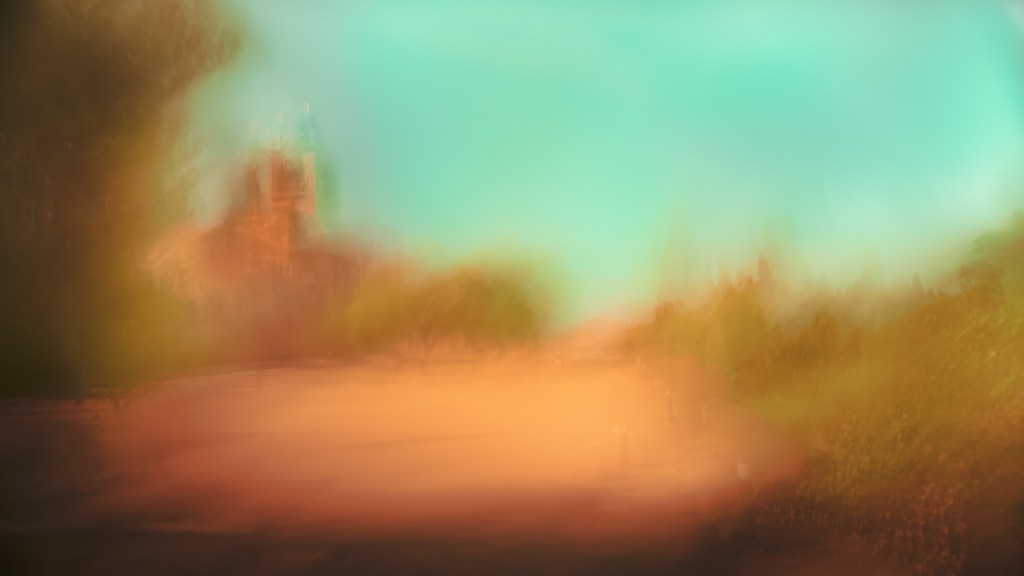
In the series “Dreams of Tuscany”, Doug Chinnery fully embraces his identity as the “Rothko of the Camera.” He strips the Italian landscape of its tourist clichés, reducing hills and cypress trees to vibrating fields of color. Through a masterful, fluid “legato” motion, he creates a visual atmosphere where earth and sky merge into a chromatic haze of siennas, ochres, and olive greens. The series is a study in atmospheric dissolution, where the solidity of the Tuscan land is transmuted into a dreamlike, translucent meditation, proving that for Chinnery, the landscape is merely a canvas for the expression of pure light and silence.
Dark Ocean
Doug Chinnery is the photographic heir to Mark Rothko, possessing the textural soul of a classical fresco painter. His work represents the ultimate shift toward pure abstraction, where form, color, and light merge into a coarse, organic surface. Unlike the “single-shot” purists, Chinnery embraces layered editing as a core creative pillar; he uses multiple exposures and textural overlays—often from rusted metals or aged plaster—to build a sense of physical weight. In series like “Dark Ocean”, he applies these layers with a painterly touch, using blending modes to let the light breathe through the “cracks” of the digital canvas. Frequently employing a square format ((1:1)), he strips the image of its geographic identity to focus on the vibration of color fields. In Chinnery’s hands, ICM is a process of visual alchemy, turning the solid world into a translucent, emotional, and tactile presence—occupying the sacred space where the landscape ends and the raw, physical resonance of light begins.
Images of Elsewhere
Images of Elsewhere represents Chinnery’s most expressionist and colour-rich body of work, using dynamic ICM gestures—arcs, vibrations, and layered sweeps—to create shimmering atmospheres that dissolve recognisable landscapes into fields of emotional colour. Greens, reds, golds, and deep blues blend into softly fractured surfaces that recall abstract painting more than observational photography. Conceptually, the series explores displacement and dream-territories, conjuring a sense of an imagined place beyond geography—an “elsewhere” constructed from movement, sensation, and intuitive response.
3.6 Synthesis — The Architecture of a Generation
Together, these five artists built what can now be considered the first canon of ICM photography. Their approaches differ — expressionist, structural, meditative, scientific, pedagogical — yet all share the same principle: the photograph as gesture, the world as rhythm. They transformed the act of photographing into a choreography of perception. Between them, they encompass the full spectrum of movement: from the anarchic to the precise, from the ecstatic to the serene. Their legacy is not only aesthetic but philosophical — they redefined what it means to see through time.
From Friel’s fire to Sirén’s silence, from Gray’s geometry to Malm’s chromatic harmony, and from Chinnery’s bridge to the future, the ICM movement found its architecture. They proved that abstraction in photography can be as deep, emotional, and disciplined as any other art form. Theirs is not a style but a foundation — the root system from which new visions will grow. The light they set in motion continues to move through every photograph that dares to dance with time.
4. The Future of Motion
The story of Intentional Camera Movement is still being written. What began as an act of curiosity has matured into a language — a way of thinking through light, time, and emotion. The five pioneers of the movement established its grammar, but not its limits. Their legacy is not a closed circle, but an open horizon.
ICM stands today at a decisive threshold. It has proven that abstraction can remain photographic, that motion can preserve truth, and that gesture can embody both science and spirit. The next chapter will depend on those who continue to explore its possibilities — artists capable of merging intuition with reflection, sensitivity with theory.
In a world increasingly dominated by automation and artificial vision, ICM reminds us that photography is still a human act: a dialogue between body and light, between chaos and form. Each movement of the camera becomes a heartbeat against the mechanical, a refusal to let perception be programmed.
The future of ICM will not be defined by style, but by depth of vision — by those who understand that abstraction is not escape, but revelation.
The camera will continue to move, not to blur the world, but to rediscover it — again and again — as vibration, memory, and light.
Epilogue — The Second Wave of Pure ICM (2020–2030)
As the pioneers defined the language of movement, a second wave began to rise — artists shaped not by tradition, but by the convergence of intuition, digital light, and post-photographic thought. Patryk Kuleta (Trynidada, Poland) brought architectural geometry into the realm of emotion, merging ICM motion with digital fusion to create a new, viral aesthetic of modern abstraction. Alexander Shapovalov (Russia) turned the urban landscape into a lyrical and psychological map, translating the pulse of cities into a choreography of color and shadow. Stephanie Johnson (USA), founder of ICMPhotoMag, became both artist and architect of a global community, bridging the gap between movement and pedagogy, between creative solitude and shared evolution. Wim van Teeffelen (Netherlands) reintroduced purity — every tone deliberate, every gesture balanced — reminding us that control can also be poetry. And David Day (UK) sought silence in luminosity, carrying the spiritual minimalism of ICM into a meditative, almost musical space.
Together they represent the dawn of a new generation — one that no longer asks what ICM is, but what it can become.
Text and research by Héctor Morón Solís (2025)
The Five Masters (quick guide)
