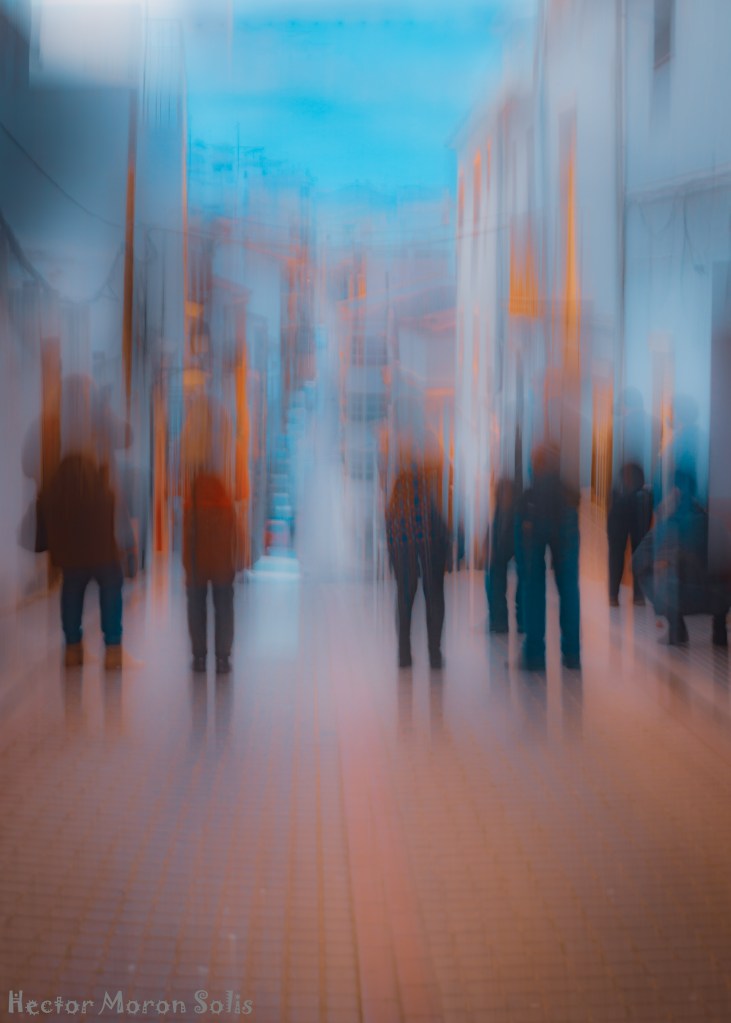
Urban Alignment transforms an ordinary street into a vision of collective trance. Human figures stand aligned along the pavement, reduced to silhouettes — almost specters of habit rather than people. They appear suspended between motion and stillness, facing a narrow path that climbs toward the light. The perspective pulls the eye upward, suggesting transcendence, yet the geometry of the city encloses them: parallel façades and grids confining what seems to aspire beyond them.
The image is divided by color and tension. The orange light of the buildings glows like an artificial warmth — the trace of civilization — while the blue atmosphere seeps through every contour, evoking distance, detachment, and sky. Their opposition creates a dialogue between containment and escape: the heat of human order against the cool breath of the infinite.
Through intentional camera movement, bodies lose their individuality. They become apparitions, echoes of presence shaped by repetition. The blur transforms identity into pattern, showing how the urban rhythm absorbs the personal into the collective. Yet within that anonymity, a faint spirituality remains: the path that rises at the center, vanishing into brightness, becomes a metaphor for the persistent human desire to reach beyond structure — to ascend while surrounded by walls.
Within the language of Allegorical Abstractionism, this photograph speaks of modern alignment: the silent choreography of lives moving together yet apart, guided by systems, longing for light. It is both order and yearning — the architecture of humanity mirrored in motion and color.
Urban Alignment transforma una calle ordinaria en una visión de trance colectivo. Las figuras humanas se alinean sobre el pavimento, reducidas a siluetas —casi apariciones más que personas reales—. Permanecen suspendidas entre el movimiento y la quietud, orientadas hacia un estrecho camino que asciende hacia la luz. La perspectiva arrastra la mirada hacia lo alto, insinuando trascendencia, aunque la geometría de la ciudad las encierra: fachadas paralelas y cuadrículas que confinan aquello que intenta elevarse más allá de ellas.
La imagen se construye sobre una tensión cromática. La luz anaranjada de los edificios irradia una calidez artificial —la huella de la civilización—, mientras la atmósfera azul invade los contornos, evocando distancia, desapego y cielo. Esa oposición crea un diálogo entre el encierro y la fuga: el calor del orden humano frente al aliento frío del infinito.
El movimiento intencionado de cámara disuelve las identidades. Los cuerpos se convierten en espectros, ecos de presencia moldeados por la repetición. El desenfoque transforma la individualidad en patrón, mostrando cómo el ritmo urbano absorbe lo personal dentro de lo colectivo. Sin embargo, dentro de esa anonimidad persiste una leve espiritualidad: el camino que asciende en el centro, desvaneciéndose en la claridad, se convierte en metáfora del deseo humano de ir más allá de la estructura —de ascender mientras se está rodeado de muros.
Dentro del lenguaje del Abstraccionismo Alegórico, esta fotografía habla de la alineación moderna: la coreografía silenciosa de vidas que avanzan juntas pero separadas, guiadas por sistemas, anhelando la luz. Es al mismo tiempo orden y deseo —la arquitectura de la humanidad reflejada en el color y en el movimiento.

Leave a comment