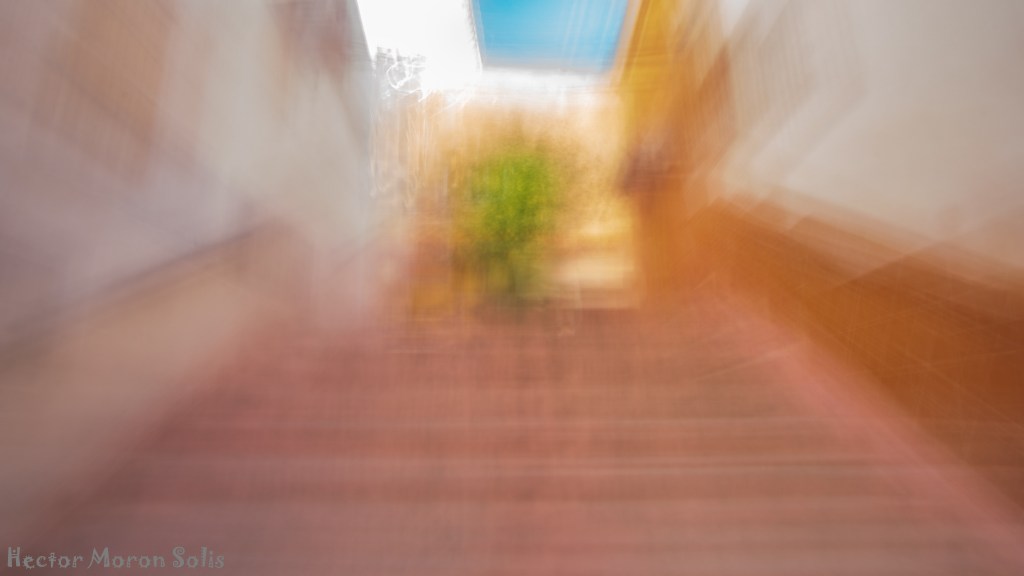
The first image of the Eden Tree Series establishes the visual and symbolic foundation of the entire cycle. A solitary tree rises at the center of the composition, emerging from a terrain of soft motion — the ground appears to tremble, as if shaped by the same breath that animates the sky. The tree stands upright, slightly offset from perfect symmetry, but still commanding balance. Its trunk glows with inner light, and its crown radiates tones of green, gold, and faint amber — the chromatic core of the series.
In the lower part of the frame, a sequence of steps leads toward the tree — a small, ascending path that cuts through the blur. These steps are not decorative; they are structural and moral. They symbolize the human path toward what is good, whole, and elevated. Each step implies effort, discipline, and perseverance — the invisible work required to reach harmony. In this sense, the ascent toward the tree becomes a reflection of the human journey itself: slow, imperfect, but illuminated by intention.
Around this axis, space dissolves. The terrain melts into fluid gestures of earth and root, while the upper zone expands in a swirl of luminous air. The camera movement — slow, vertical, deliberate — extends the branches into translucent arcs, suggesting both ascension and vibration. There is no single source of light: illumination emanates from within the tree itself, as if its substance were composed of energy rather than matter.
Each element participates in the allegory. The roots, half visible, represent memory and origin — the grounding of existence. The trunk, vertical and tense, acts as the axis of endurance. The crown, glowing between gold and green, embodies the reward of the climb: the state of spiritual clarity that comes after effort. Even the blurred surroundings contribute to this idea — they are not absence, but transformation, the passage from chaos to meaning.
The composition evokes equilibrium, yet not serenity. There is tension within the calm — a sense that the tree resists dissolution through pure radiance. Light and darkness coexist without victory or defeat; instead, they sustain each other in fragile balance. The viewer perceives not a static landscape but a suspended act of becoming: creation caught in the act of renewal.
This is the Eden Tree before the fall — the image of a world in balance, where ascent still leads to harmony. It reminds us that all that is luminous in life demands effort; that the path to goodness is not given, but climbed. The steps to Eden are the measure of our will.
La primera imagen de la Serie Eden Tree establece los cimientos visuales y simbólicos de todo el ciclo. Un árbol solitario se alza en el centro de la composición, emergiendo de un terreno en suave movimiento: el suelo parece vibrar, como si estuviera modelado por el mismo aliento que anima el cielo. El árbol se erige recto, ligeramente desplazado del eje perfecto, pero dominando el equilibrio. Su tronco irradia una luz interior, y su copa resplandece en tonos de verde, oro y ámbar tenue — el núcleo cromático de la serie.
En la parte inferior del encuadre aparece una escalinata que asciende hacia el árbol, una pequeña senda que corta el desenfoque. No es un elemento decorativo, sino estructural y moral. Representa el camino humano hacia lo bueno, lo íntegro y lo elevado. Cada peldaño implica esfuerzo, disciplina y perseverancia: el trabajo invisible que exige alcanzar la armonía. En este sentido, la subida hacia el árbol refleja el propio recorrido vital del ser humano — lento, imperfecto, pero guiado por una voluntad luminosa.
En torno a este eje, el espacio se disuelve. El terreno se funde en gestos fluidos de tierra y raíz, mientras la parte superior se expande en un remolino de aire luminoso. El movimiento de la cámara — lento, vertical, deliberado — prolonga las ramas en arcos traslúcidos, que sugieren a la vez ascensión y vibración. No hay una fuente única de luz: la iluminación parece emanar del propio árbol, como si su materia estuviera compuesta de energía más que de sustancia.
Cada elemento participa de la alegoría. Las raíces, medio visibles, representan la memoria y el origen — la base que sostiene la existencia. El tronco, vertical y tenso, actúa como eje de resistencia. La copa, resplandeciente entre dorados y verdes, encarna la recompensa del ascenso: el estado de claridad espiritual que llega tras el esfuerzo. Incluso el entorno difuminado tiene un propósito: no es ausencia, sino transformación, el paso del caos al significado.
La composición transmite equilibrio, aunque no serenidad. Hay tensión dentro de la calma: una sensación de que el árbol se defiende de la disolución mediante la luz. Claridad y sombra conviven sin vencedores ni vencidos; se sostienen mutuamente en un equilibrio frágil. El espectador no contempla un paisaje estático, sino un acto suspendido de creación, un instante en que la naturaleza se renueva a sí misma.
Este es el Árbol del Edén antes de la caída, la imagen de un mundo en equilibrio, donde el ascenso aún conduce a la armonía. Nos recuerda que todo lo luminoso en la vida exige esfuerzo; que el camino hacia lo bueno no se concede, se conquista. Los peldaños hacia el Edén son la medida de nuestra voluntad.

Leave a comment