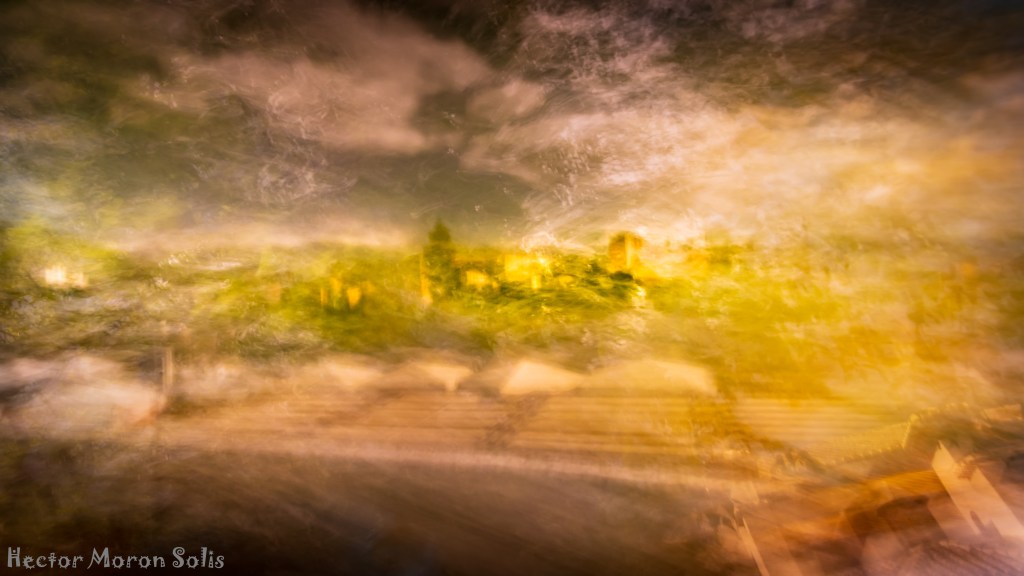
Friel was a painter before he was a photographer, and that background is evident in his “eye”: he doesn’t capture scenes, but rather interprets them using the sensor as a canvas and camera movement as a brush to create images that evoke expressionist melancholy paintings. Unlike other ICM photographers who move the camera throughout the exposure, Friel employs a mixed technique of initial stillness to record recognizable forms followed by a final movement (often forward or rapid jerks) that creates an ethereal, enveloping trail. His color blindness (protanopia) was the catalyst that, around 2010, led him to abandon black and white and embrace a unique color palette focused on contrast, light, and emotional abstraction rather than chromatic fidelity. This shift solidified his rejection of complex post-processing, preferring compositional simplicity and the use of tilt-shift lenses to generate points of surgical sharpness amidst a sea of blur, thus capturing the impermanence of the moment directly in the camera.
After
“After” (Series and PhotoBook), is perhaps his most emotional and intimate series. It was created in 2016, shortly after his son Joe committed suicide. The images, many in black and white, were taken on the Isle of Harris and Lewis (Scotland), a place Joe loved. His themes explores grief, loss, and memory. Regarding aesthetics, the photographs are deeply melancholic, using ICM to evoke the fragility of memories and the feeling that things fade away. They feature vast landscapes with blurred or out-of-focus elements that reflect his emotional state. Chris Friel chose to display these images without frames or glass, mounted directly on the wall, for a more raw and immediate experience.
Hypergraphia
In “Hypergraphia”, Chris Friel shifts from landscape aesthetics to conceptual art and “claustro photography” as a coping mechanism, using his phone camera to record 150,000 moments in a methodological process. The work is seen as an exorcism of trauma rather than a pursuit of beauty, transforming a hospital room window into a threshold of hallucinatory visions. Friel’s titling, referencing a neurological writing compulsion, questions whether the creation is art or a symptom, resulting in a unsettling visual narrative employing serial repetition to explore extreme loneliness and self-disintegration.
Pairs
Chris Friel’s “Pairs” series involves sophisticated editing that goes beyond single images to create a language of binary dialogues based on visual rhythm and tonal resonance. Friel pairs photographs from his archive, sometimes taken years apart, seeking organic continuity in textures, horizon lines, or ICM movement, creating diptychs that act as emotional mirrors. Within this series, the work titled “Wedding” stands out for its transition from natural landscapes to human presence; through his ICM technique, Friel deconstructs the figures into ethereal columns of light, stripping the social event of its anecdotal nature to focus on the geometry of movement. As a colorblind artist, these pairings—including the spectral whites of the wedding scene—rely on structural weight and contrast rather than chromatic fidelity, reminiscent of classical polyptychs. The resulting work demonstrates a relational minimalism where the emptiness of one shot balances the mass of another, prompting viewers to find the common essence uniting two seemingly unrelated moments into a single poetic entity.
Singles (Curated Highlights)
The Singles collection, though not a “series” in the traditional sense, functions as a curated retrospective of Friel’s strongest independent works — each image a distilled statement of his visual philosophy. Image #1, a spectral horse floating in black void, embodies his ability to transform motion into apparition; Image #2, an almost abstract portrait where the face is smeared into vertical streaks, showcases his command of emotional erasure; Image #3, a forest rendered as glittering pointillism, shows how he pushes low-light ICM into the realm of painting. Technically, these works mix short and long shutter speeds, lateral and rotational movements, and an extremely intuitive sense of tone. Conceptually, Singles is the clearest demonstration of Friel’s core identity: a photographer who paints with disappearance.
The Five Masters (quick guide)

Leave a comment