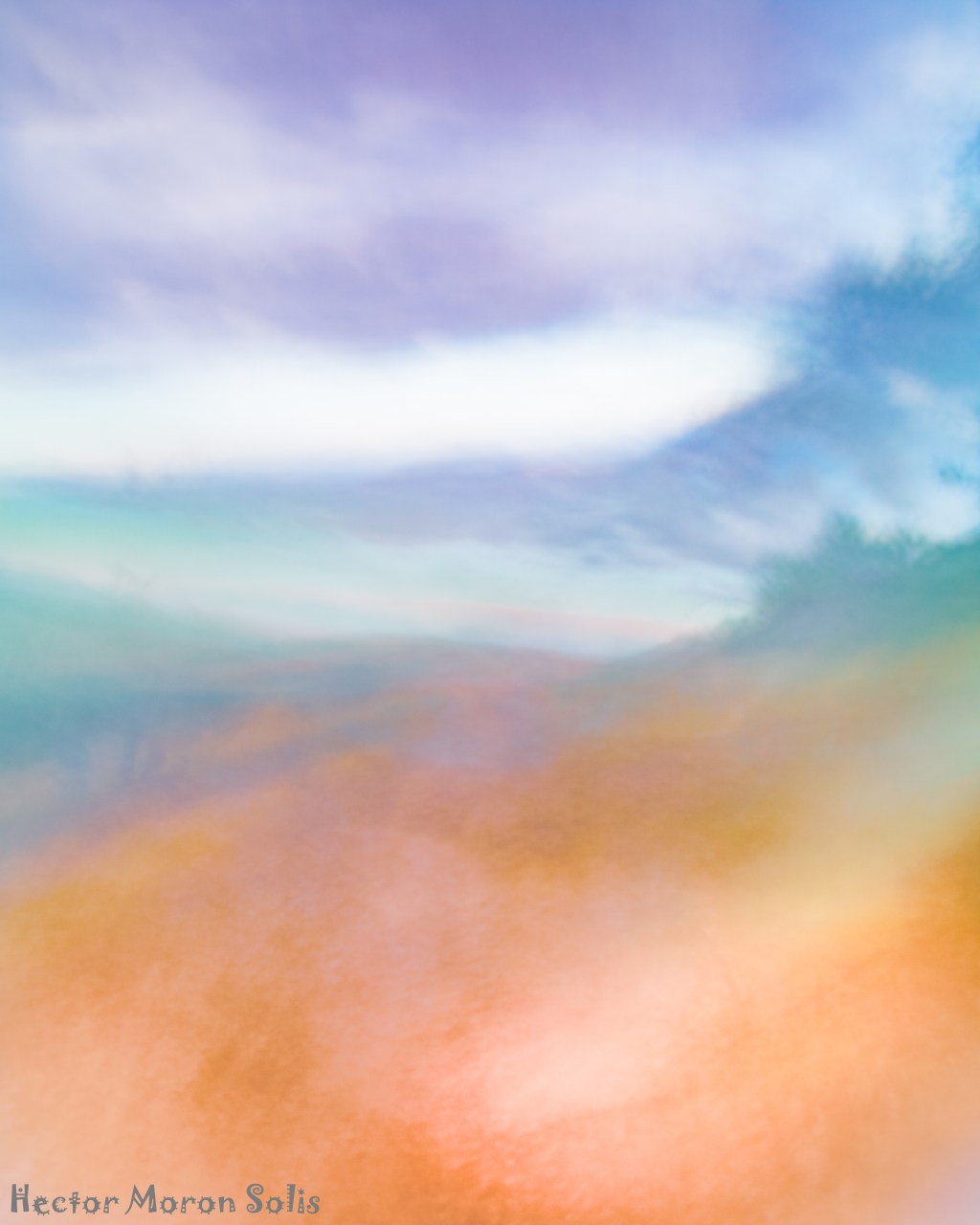
Within contemporary ICM and photographic expressionism, Doug Chinnery stands as one of its clearest abstract expressionist voices. His work shifts the focus from the external landscape to the internal landscape of feeling: colour becomes less a property of things than a vibrating emotional field, and the visible world is stripped back into atmosphere, surface, and resonance. Unlike single-exposure purists such as Erik Malm, Chinnery embraces a more layered photographic language, combining intentional movement, multiple exposure, texture, and post-processing to build images that approach painting, fresco, and abstract colour-field art. In this sense, his subject is not simply forest, sea, or horizon, but the emotional residue of place — the unseen pressure of light, memory, and mood. He is the alchemist of photographic abstraction, turning landscape into colour, texture, silence, and inner weather.
Dreams of Tuscany
In Dreams of Tuscany, one of Chinnery’s earlier abstract landscape bodies of work, the Italian landscape appears stripped of its tourist familiarity and transformed into a field of colour, atmosphere, and emotional resonance. Rather than treating Tuscany as a picturesque subject of hills, cypress trees, villages, or golden light, Chinnery seems to reduce it to chromatic memory: siennas, ochres, olive greens, pale skies, and softened earth tones merge into a dreamlike surface. The series can be read as a study in atmospheric dissolution, where landscape becomes less a place to be described than a canvas for light, silence, and internal sensation. In this sense, Dreams of Tuscany already points toward Chinnery’s abstract-expressionist identity: photography moving away from topography and toward colour-field emotion.
Dark Ocean
In Dark Ocean, Chinnery’s photographic language can be read in relation to Mark Rothko and to the physical surfaces of fresco, plaster, rust, and weathered paint. The series represents one of his clearest movements toward pure abstraction, where form, colour, light, and texture merge into a coarse, organic surface. Unlike single-exposure purists, Chinnery embraces a more layered photographic process, using intentional movement, multiple exposure, post-processing, and textural intervention as part of the work’s expressive structure. In Dark Ocean, the image is stripped of geographic identity and becomes a dark field of resonance: light seems to breathe through cracks, stains, and translucent layers, while the sea is no longer a place but a pressure, a weight, an emotional surface. The frequent use of square format reinforces this movement away from landscape description toward pictorial concentration. In Chinnery’s hands, abstraction becomes a process of visual alchemy, turning the solid world into a translucent, tactile presence — a place where landscape ends and the physical resonance of light begins.
Images of Elsewhere
Images of Elsewhere can be read as one of Chinnery’s most expressionist and colour-rich earlier bodies of work, using dynamic ICM gestures, layered surfaces, arcs, vibrations, and sweeping movements to dissolve recognisable landscapes into fields of emotional colour. Greens, reds, golds, and deep blues appear less as descriptive tones than as states of feeling, blending into fractured surfaces that recall abstract painting more than observational photography. Conceptually, the series explores displacement and dream-territories: an “elsewhere” not defined by geography, but constructed from movement, sensation, memory, and intuitive response. Within Chinnery’s wider practice, the series helps clarify his abstract-expressionist direction — the landscape no longer functioning as destination or view, but as a threshold into imagined colour, inner weather, and emotional elsewhere.
Iomall an t-Saoghail – The Edge of the World
In Iomall an t-Saoghail – The Edge of the World, Chinnery’s recent language becomes more territorial, material, and elemental. Inspired by the landscapes of his home in the Outer Hebrides, the project reduces land, sea, sky, and weather to essential signs: dark horizon-lines, rust-red suns, grey-blue atmospheres, blocks of oxidised earth, mineral textures, and surfaces that feel eroded by salt, wind, and time. Unlike his more fluid colour-field works, these images are flatter, rougher, and more tectonic, closer to fresco, weathered wall, map, or ancient mark than to conventional landscape. The landscape is not represented so much as excavated; what remains is its residue — isolation, edge, matter, silence, and Atlantic weather. In this series, Chinnery does not dissolve the world into pure colour, but compresses it into symbolic fragments, turning the Outer Hebrides into a tactile meditation on distance, erosion, and the end of the known world.abstract painting more than observational photography. Conceptually, the series explores displacement and dream-territories, conjuring a sense of an imagined place beyond geography—an “elsewhere” constructed from movement, sensation, and intuitive response.
The Five Masters (quick guide)

Leave a comment