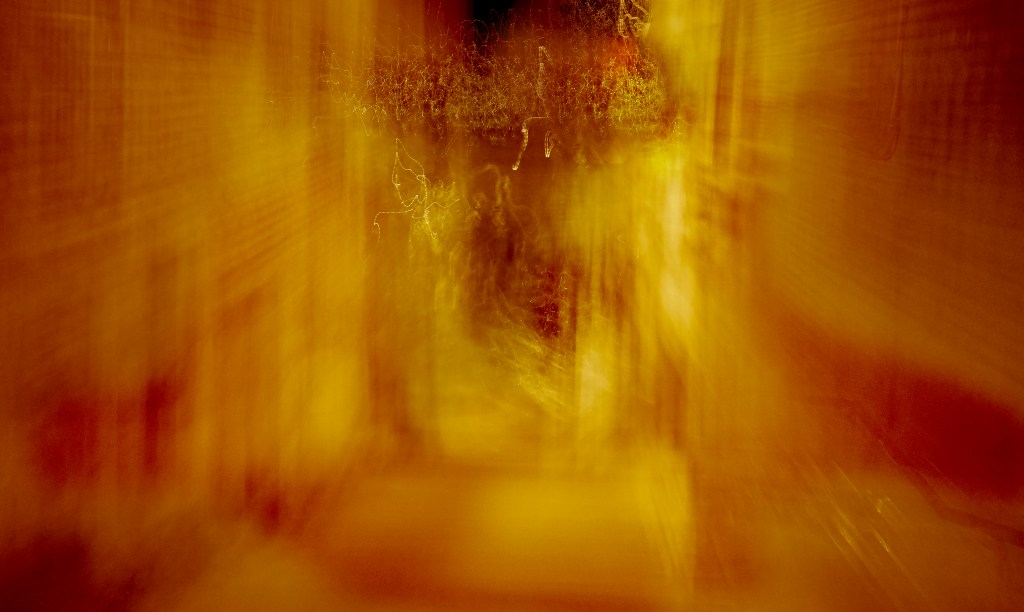
Andrew S. Gray’s work represents the most formalist and structural aspect of the Intentional Camera Movement, distancing itself from Friel’s melancholic expressionism to embrace a graphic and rhythmic abstraction. While Friel dissolves reality through his technique of stillness and shaking, Gray acts as a “stratifier” of the landscape, employing linear sweeps of constant speed—generally vertical in wooded environments—that transform organic matter into textures of almost textile purity. His mastery lies not in capturing chance, but in an extremely controlled geometry of movement that emphasizes chromatic saturation and compositional order, turning tree trunks and horizons into vibrant patterns that oscillate between contemporary design and chromatic minimalism. Based on his publications in On Landscape and his teaching work, it is confirmed that his methodology replaces Friel’s emotional “brushstroke” with absolute technical fluidity, where the use of stable supports and precise shutter speeds allows color and line to crystallize into an aesthetic of visual harmony, stripped of existential anguish to focus on the pure vibration of light.
Abstract Landscapes — Part I
In “Ruins of St. Mary’s Abbey“, York, Gray fuses architectural memory with motion, turning the medieval stone arches into trembling silhouettes that dissolve into the dusk light—an exemplar of his ability to make history flicker like breath. Arrival and the Land of the Cyclopes pushes this further into mythic abstraction: a shoreline rendered as a single sweeping diagonal, its colours compressed into a storm of ochres and steel blues, suggesting both the violence and the poetry of approaching land. In Loss Series: “Faltering Under the Fury” (2015), perhaps the most emotionally charged of the group, Gray uses dense lateral movement to fracture the horizon, creating a landscape that feels wounded yet luminous; the blur becomes metaphor, a rupture in light itself. Finally, “Bamburgh Castle on an August Evening” anchors the series in coastal drama—its fortress reduced to a ghostly glow above a molten sky, the long shutter transforming waves into a ribbon of soft fire. Together, these works articulate the foundations of Abstract Landscapes I: motion as architecture, colour as atmosphere, and landscape as a memory trembling into abstraction.
Abstract Landscapes — Part II
In Lanscapes II, Andrew S. Gray employs a “liquid” style where extreme post-processing transforms initial captures into images resembling 19th-century oil paintings. “Psychedelic Harbottle” uses vibrant, unreal colors and a vibrating movement to disintegrate stone, while “Lindisfarne” focuses on minimalism through smooth diagonal sweeps that merge sky and sand. “Dryburgh Abbey Study” reflects the influence of J.M.W. Turner, combining a brief static phase with upward movement and post-processing that accentuates golden tones.
Abstract Landscapes — Part III
In “Standing Stones”, Gray turns ancient monoliths into flickering sentinels—the long exposure softens their mass into trembling silhouettes, as if history itself were vibrating beneath the sky; the motion is restrained, a slow lateral drift that preserves the stones’ dignity while dissolving their edges into myth. Solstice expands this atmospheric quietude into something cosmic: warm golds and cold blues slide across the frame in a single suspended gesture, the landscape reduced to pure luminance, a meditation on seasonal light rather than geography. With “Quirang”, Gray confronts one of Scotland’s most dramatic terrains and renders it nearly abstract—its jagged escarpments melt into vertical veils of green and grey, turning raw geology into a painterly cascade that feels more like memory than observation. Finally, “The Great Whale” pushes his poetic minimalism to its limit: a vast pale sweep, almost empty, where a single soft curvature evokes the back of a breaching creature beneath a sky of muted silver. Together these works define Abstract Landscapes III as Gray’s most introspective and atmospheric phase—where landscapes become breath, stone becomes apparition, and motion becomes a language of quiet revelation.
Abstract Landscapes — Part IV
Abstract Landscapes IV marks the moment where Gray moves from atmospheric restraint into a more luminous, emotionally open phase: colours become fuller, exposures slightly wider, and the ICM gesture slow enough to stretch light without fracturing form. The landscapes here are no longer dissolved memories (como en la III) but rather sustained emotions, almost chromatic meditations, where each sweep contains a distinct emotional intention. “New Dawn, Old Scene” (2021) is the manifesto of this maturity: a golden field of diffused light where movement transforms the morning into a warm sigh; the scene is not new, but the emotion is—a rebirth on the same horizon. Home Evenings captures the opposite tone: soft blues and warm browns shifted laterally, the long gesture that transforms a domestic afternoon into something intimate and fragile, a landscape that breathes as if it were a personal memory. “Pier Light” introduces structure: precise horizontals that support an orange glow vibrating in the center of the painting, an almost musical balance between architectural form and chromatic dissolution, one of his most “drawn” pieces within the movement. And “Ruins by Moonlight” – Warkworth Castle demonstrates his total technical control: deep shadows, a translucent arc of light, and minimal movement that envelops the ruins in a spectral halo without losing their character; it is nocturnal poetry created with discipline. Overall, Abstract Landscapes IV is his most mature and complete phase: color without exuberance, structure without rigidity, emotion without excess—the final synthesis of everything he has learned throughout his career.
The Five Masters (quick guide)

Leave a comment