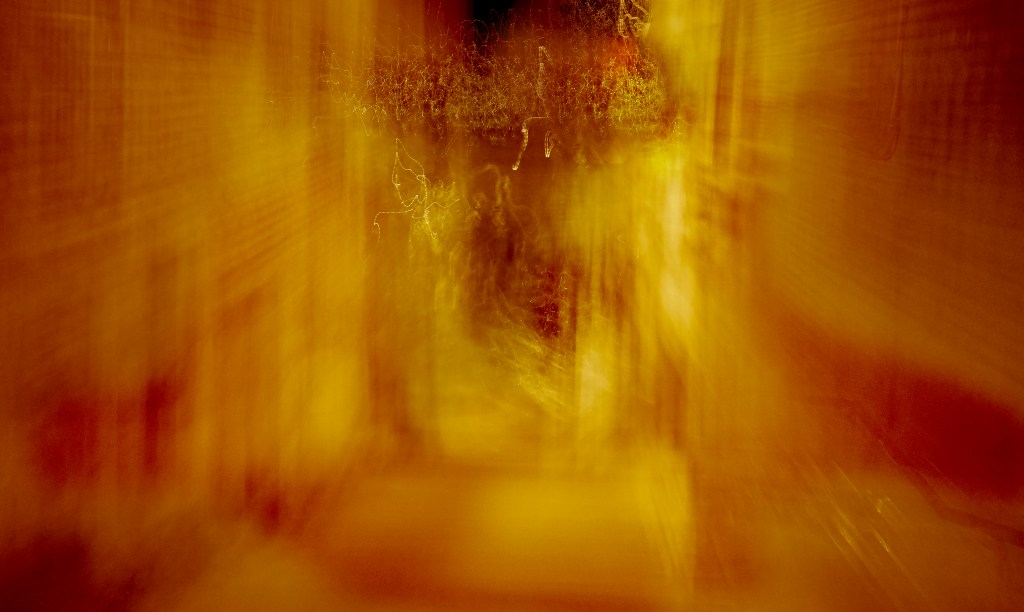
Andrew S. Gray’s work represents one of the most formalist and structural directions within Intentional Camera Movement, moving away from Friel’s melancholic expressionism toward a more graphic, rhythmic, and design-oriented abstraction. Where Friel often dissolves reality through stillness, blur, and sudden disturbance, Gray acts more like an architect of motion: he stratifies the landscape through controlled sweeps, transforming coastlines, historic ruins, castles, abbeys, lighthouses, and horizon lines into vibrating icons. His mastery lies not in allowing chance to dominate, but in imposing a disciplined geometry of movement that turns recognisable landmarks into chromatic structures, somewhere between landscape photography, contemporary design, and abstract painting. In Gray’s work, architectural heritage is not merely documented; it is reconfigured into rhythm, silhouette, and colour, so that ruins and coastal forms become visual emblems rather than descriptive records. His palette often intensifies this sense of emblematic transformation, moving from pale lunar yellows and muted ochres to burnt oranges and saturated, decadent reds, giving his coastal and architectural subjects an atmosphere that feels at once historical, graphic, and dreamlike. At the same time, his language should not be reduced to pure in-camera movement: his public teaching, his On Landscape feature, and his own emphasis on ICM editing techniques point to a practice where capture, movement, processing, and sequencing work together. The result is an aesthetic of visual harmony in which line, colour, and historical form crystallize into images less burdened by Friel’s existential melancholy and more focused on the pure vibration of light, texture, architecture, and motion.
Abstract Landscapes — Part I
In Ruins of St. Mary’s Abbey, York, Gray fuses architectural memory with motion, turning the medieval arches into trembling silhouettes that dissolve into dusk light and showing how historical form can be transformed into a fragile, vibrating presence. Arrival and the Land of the Cyclopes pushes this further into mythic abstraction: the shoreline is dominated by a sweeping diagonal, while ochres and steel blues compress the scene into a field of tension, suggesting both the violence and the poetry of approaching land. In Loss Series: Faltering Under the Fury (2015), one of the most emotionally forceful works in the group, Gray uses dense lateral movement to fracture the horizon, creating a landscape that feels both wounded and luminous; here, blur functions less as atmosphere than as a metaphor for rupture within the field of light. Finally, Bamburgh Castle on an August Evening anchors the group in coastal drama: the fortress is reduced to a ghostly glow above a molten horizon, while the long exposure transforms the waves into a ribbon of soft fire. Together, these works articulate the foundations of Abstract Landscapes I: motion as architecture, colour as atmosphere, and landscape as a historical and emotional form trembling into abstraction.
Abstract Landscapes — Part II
In Landscapes II, Andrew S. Gray moves toward a more liquid and painterly mode, where movement and intensive post-processing transform the initial capture into images that recall 19th-century landscape painting. Dryburgh Abbey Study is the clearest Turnerian example: the abbey emerges through red, ochre, and golden vapour like a historical apparition, its architectural form half-preserved and half-consumed by atmospheric light. Psychedelic Harbottle pushes this painterly transformation into a more radical chromatic register, using acidic yellows, turquoise, ochres, and saturated reds to destabilize the solidity of stone until the ruin becomes less a monument than a field of altered perception. Lindisfarne, by contrast, is more restrained and crepuscular: land, sea, and sky dissolve through an organic, rhythmic panning movement rather than a straight linear sweep, allowing the orange horizon light to spread across the image like weather, memory, and tide. Together, these works show Gray at his most painterly: motion and processing do not merely blur the scene, but liquefy historical and coastal forms into colour, atmosphere, and luminous residue.
Abstract Landscapes — Part III
In Abstract Landscapes III, Gray moves further away from the architectural icon and the descriptive shoreline toward a more elemental language of atmospheric motion. Here, the true subject is often not the landmark itself, but the movement of air, light, cloud, wind, and colour across the image. In Standing Stones, the ancient archaeological subject is reduced to a small dark presence within a vast amber-brown field, while the surrounding motion creates a cavernous, almost cosmic curve that turns stone into memory and landscape into psychological enclosure. Solstice expands this direction into pure luminance: warm whites, golds, pinks, and soft reds slide across the frame in a suspended burst of seasonal light, reducing geography almost entirely to radiant weather. With Quiraing, Gray confronts one of Scotland’s most dramatic terrains, but instead of preserving its geological sharpness, he transforms it into a red and violet field of atmospheric pressure beneath a pale, unstable sky, turning land into something wounded, visceral, and painterly. Finally, The Great Whale carries this poetic abstraction into a softer, biomorphic register: a vast pastel field of pinks, corals, creams, and muted violets surrounds a delicate central curvature, evoking a submerged or surfacing creature more than a conventional landscape. Together, these works define Abstract Landscapes III as one of Gray’s most introspective phases, where wind, sky, light, and colour become the true architecture of the image, and motion becomes a language of quiet revelation.
Abstract Landscapes — Part IV
Abstract Landscapes IV marks the moment where Gray moves from the atmospheric inwardness of Part III into a more luminous, emotionally open, and technically distilled phase. Colours become fuller yet softer, the tonal fields more expansive, and the ICM gesture slow enough to stretch light without completely fracturing form. The landscapes here are no longer dissolved memories, as in Part III, but sustained emotions — chromatic meditations where each movement seems to carry a distinct emotional temperature. New Dawn, Old Scene (2021) becomes the manifesto of this maturity: an almost weightless field of pale gold and diffused morning light, where movement transforms the familiar horizon into a warm breath of renewal. Home Evenings deepens this intimacy through amber mist, soft browns, and a central glow that turns the familiar landscape into something private and fragile, less a view than a remembered atmosphere. Pier Light introduces coastal structure in a highly dissolved form: land gathers as a dark mass on the left, the sea opens into radiant light on the right, and a small red-and-white lighthouse-like form anchors the centre, preventing the image from becoming pure atmosphere; around it, orange, violet, and white light spread across the frame, creating a quiet balance between maritime architecture, chromatic dissolution, and the threshold between land and sea. Ruins by Moonlight – Warkworth Castle demonstrates Gray’s disciplined nocturnal control: deep blue-green shadows, a suspended moon, and restrained movement envelop the ruins in a spectral halo without erasing their identity. Overall, Abstract Landscapes IV can be read as one of Gray’s most mature and complete phases: colour without exuberance, structure without rigidity, emotion without theatricality — a synthesis of the atmospheric, architectural, chromatic, and poetic dimensions developed throughout his career. exuberance, structure without rigidity, emotion without excess—the final synthesis of everything he has learned throughout his career.
The Five Masters (quick guide)

Leave a comment