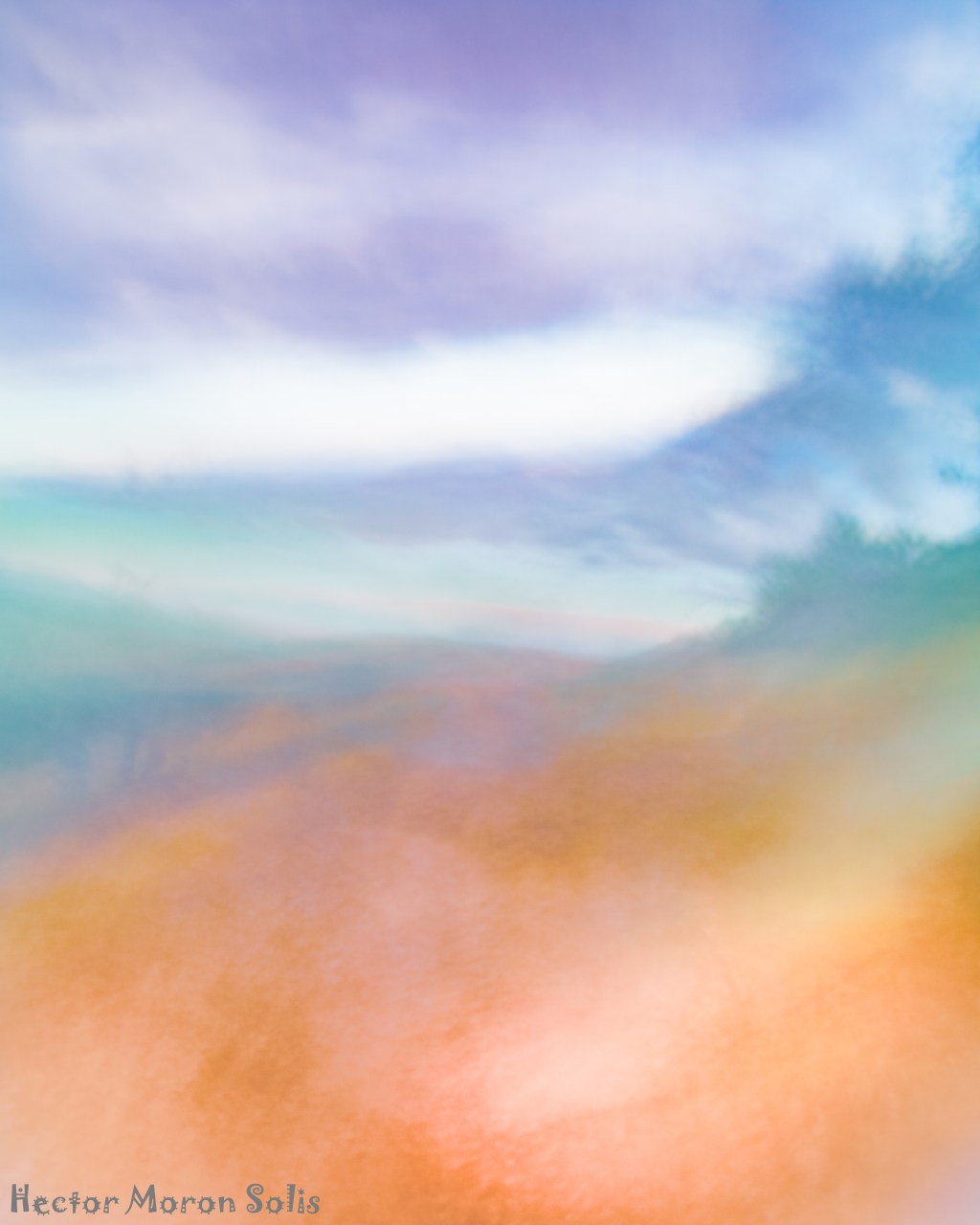
Among the masters of Pure ICM, Erik Malm stands as the scientist and maestro of motion and deep depth of field , transforming intuition into a symphonic method of chromatic hyper-structure. Unlike the single “still-then-move” anchor used by Chris Friel, Malm employs a sophisticated “multiple stop-and-go” technique—a visual staccato executed throughout exposures of 0.5 to 8 seconds. By conducting the camera with a sequence of micro-pauses followed by rapid, rhythmic displacements, he allows the sensor to record the absolute purity of each pigment before jumping to the next. This disciplined “peining of light” prevents colors from contaminating each other, resulting in a liquid geometry characterized by a grain of luminous threads and concentric fibers. Drawing from his background as a solo clarinetist and his rigor in ergonomic research, Malm avoids the blurry mess of traditional motion to create a high-definition digital pointillism. In his hands, ICM becomes a polished, vibrant performance where light seems to emanate from carved crystals, proving that beauty emerges not from spontaneity, but from the perfect orchestration of vibration, exactness, and chromatic separation.
Landscape Gallery
In his “Landscape Gallery”, Erik Malm reaches the pinnacle of tridimensional abstraction, achieving what art criticism defines as spatial stratification. Through his visual staccato and rapid micro-movements, Malm does not merely stretch color; he physically “sculpts” the depth of the image, clearly differentiating the proximal term (foreground), the middle plane, and the distal background. This unique ability to maintain the structural integrity of shrubs and hills while enveloping them in spectral vortices of light creates a dynamic sfumato: an atmospheric perspective built through chromatic vibration rather than traditional lines of flight. His compositions of parallel hills and defined bushes prove that his “multiple stop-and-go” method allows objects to retain their physical identity while rotational movements generate a ghostly energy around them. The result is a capillary resonance where each layer of the landscape breathes independently, defying the flatness of traditional ICM to offer a profound sense of sculpted space.
Animal Collection
The “Animal Collection” is Malm’s most experimental and risk-heavy body of work: animals are transformed into flowing masses of motion, where biology dissolves into energy. His technique is unusually bold—ICM while tracking fast-moving subjects—resulting in silhouettes that hover between recognition and abstraction. The palette tends toward earthy neutrals and muted blues, reflecting natural environments rather than the vibrant chromatic overlays of his landscapes. Technically, this collection demonstrates mastery over instability: panning motions combined with subtle roll or tilt, executed at shutter speeds longer than traditional wildlife photography allows. Conceptually, the collection explores the tension between presence and disappearance, turning wildlife into symbols of fragility and transience. Though less iconic than his landscapes, these works show his range and technical audacity.
Lighthouse Gallery
In the “Lighthouse Gallery”, Erik Malm applies his “visual staccato” technique to an environment of architectural rigidity and extreme directional light, where the lighthouse serves as a vertical axis of symmetry. Malm deconstructs the structure to explore the duality between the solidity of the stone and the immateriality of its flash. He uses micro-lateral movements to create a “tectonic vibration” effect on the lighthouse silhouette and employs spatial stratification to maintain sharpness at the base while dissolving the lantern into luminous threads . Through long exposures, the sea becomes a polished metallic surface and the sky appears as chromatic silks framing the lighthouse. The most striking aspect is how Malm photographs the light beam, transforming it into a solid light sculpture through ICM, generating spectral vortices. Malm maintains the integrity of the single shot, making the lighthouse the anchor in a world that fades. You can view the full gallery at Erik Malm’s website.
Bird Collection
The “Bird Collection” is Malm’s lyrical counterpart to his more structured landscapes. Here, ICM traces the movement of wings, turning flight into gesture. Some works lean toward figurative silhouettes; others dissolve birds entirely into flickering strokes of white or color. Technically, these images require exquisite timing: shutter speeds often between 1/10 and 1 second, combined with precise tracking that transforms flapping motion into calligraphic marks. Emotionally, the collection speaks of freedom, fragility, and impermanence—birds rendered as the pure trace of their passage through air. Although not as chromatically complex as his Landscapes, this body of work showcases Malm’s sensitivity to temporal rhythm and his ability to transform speed into poetry.
The Five Masters (quick guide)

Leave a comment