Erik Malm ICM Technique: Camera Painting, Colour and Rhythm
Erik Malm is a Swedish ICM photographer and camera painter known for long exposure, single-exposure abstraction, colour rhythm and disciplined camera movement. Among the masters of Pure ICM, Erik Malm stands as the musician-scientist of motion: a photographer who transforms exposure into a performed translation of time, perception, and musical structure. His images are single exposures made at the moment of capture, without compositing, digital assembly, or trick-effect filters, apart from ND fader filters when needed; the post-process is limited to adjustments of contrast and colour saturation. Malm describes his method as “camera painting”: he almost always works handheld, moving the camera in different ways during longer exposure times, from approximately 1/30 of a second to 30 seconds or more. What distinguishes many of his strongest images is not continuous blur, but a controlled alternation between registration and painting: the camera appears to stabilize briefly enough for a lighthouse, bird, tree, rock, or animal to retain its identity, before movement surrounds it with halos, currents, luminous threads, and chromatic turbulence. His background as a clarinetist, conductor, and researcher in ergonomics gives this process a rare sense of embodied precision: movement is not accidental distortion, but phrasing, tempo, rhythm, and controlled execution. Many of his images therefore seem to contain a form of visual staccato, as if moments of clarity and displacement were being articulated within the same exposure, allowing colour, line, and light to separate into crystalline fragments and rhythmic structures. Natural elements — birds, landscapes, atmospheric conditions, light, and colour — do not operate merely as subjects, but as materials within a larger visual composition, encountered and shaped during the irreversible act of exposure. In Malm’s hands, ICM becomes not a technique of disorder, but a disciplined orchestration of duration itself — a way of making time visible through light, colour, and movement.
Landscape Gallery
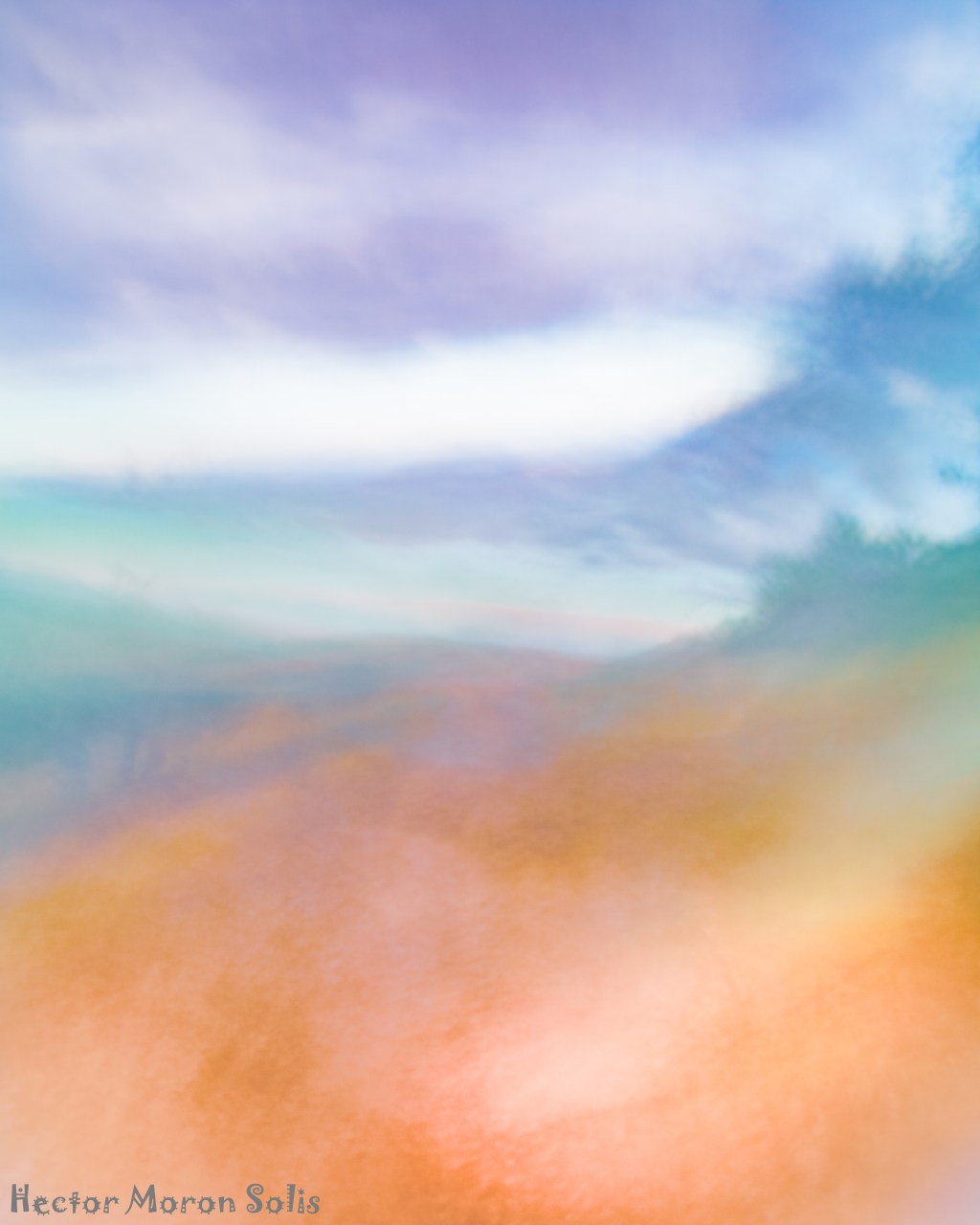
In his Landscape Gallery, Erik Malm reaches one of the clearest expressions of tridimensional abstraction, achieving what could be described as spatial stratification. Through a visual staccato of controlled handheld movement, Malm does not merely stretch colour; he seems to sculpt depth, differentiating foreground, middle plane, and distant background within the same single exposure. In one untitled landscape, dark trees remain physically present while blue, white, and golden vapours move around them like spectral weather, creating a layered field where vegetation, atmosphere, and light breathe at different distances. In another, black mountain silhouettes are surrounded by pale blue and white currents, producing an almost theatrical sense of space: the landscape keeps its physical architecture, while movement turns air into visible matter. This is Malm’s dynamic sfumato — an atmospheric perspective built not through classical linear recession, but through chromatic vibration, rhythmic displacement, and luminous turbulence. His images defy the flatness often associated with uncontrolled ICM, offering instead a profound sense of sculpted space, where each layer of the landscape seems to resonate independently.
Animal Collection
The Animal Collection is one of Erik Malm’s more experimental but also more uneven bodies of work. Here, his single-exposure camera painting is applied to living, moving subjects, transforming animals into fluctuating presences between recognition and abstraction. At its best — especially in images where stripes, silhouettes, or group movement create strong visual rhythm — the collection reveals how Malm’s method can turn biology into pattern, pulse, and atmospheric trace. Yet compared with his landscapes, these works often feel less structurally resolved: the spatial stratification, chromatic architecture, and luminous depth that define his strongest images are less consistently present. The palette tends toward earthy neutrals, greys, blacks, and muted blues, closer to natural environment than to the crystalline colour structures of his landscapes. Conceptually, the series explores fragility, movement, and animal presence, but it also exposes the limits of camera painting when the subject remains too literal or too dependent on wildlife recognition. For that reason, the Animal Collection is valuable as evidence of Malm’s range and technical ambition, but it is not among the most convincing or iconic areas of his work.
Lighthouse Gallery
In the Lighthouse Gallery, Erik Malm applies his camera-painting method to an environment of architectural rigidity, turbulent sea, and extreme directional light. The lighthouse functions as a vertical anchor: it remains surprisingly legible while the surrounding water, rocks, sky, and beam of light are transformed into moving fields of energy. This is one of the clearest examples of Malm’s stop-and-paint logic — a moment of stabilization allows the lighthouse to register, while controlled handheld movement paints halos, currents, and spectral turbulence around it. Rather than deconstructing the structure completely, Malm preserves its identity and uses it as a fixed point within a world in motion. The sea becomes metallic and turbulent, the rocks retain physical weight, and the light beam expands into a sculptural presence, almost as if illumination itself had become solid matter. The result is a dynamic tension between architecture and atmosphere: the lighthouse stands as an axis of clarity while the surrounding landscape dissolves into rhythm, vibration, and luminous weather.
Bird Collection
The Bird Gallery is Malm’s lyrical counterpart to his more spatially structured landscapes. Here, his camera painting follows the volatility of wings, turning flight into gesture and animal presence into temporal trace. Some works remain close to figurative silhouette, where the bird is still readable as a living form; others dissolve almost entirely into flickering marks, mist, dark smears, or pale movements across air and water. Technically, these images depend on an especially delicate balance between timing, handheld movement, and partial registration: the exposure must be long enough to absorb the rhythm of flight, but controlled enough to prevent the bird from disappearing into undifferentiated blur. The result is a gallery of fragile apparitions, where birds become signs of freedom, speed, impermanence, and passage. Although this body of work is generally less chromatically complex than Malm’s strongest landscapes, it reveals his sensitivity to temporal rhythm and his ability to transform movement into visual music. One of the strongest images is the penguin: its curved neck and compact body remain clearly articulated, almost sculptural, while the surrounding space dissolves into bluish veils, luminous halos, and soft painterly turbulence. The muted palette — blacks, greys, cold blues, whites, and a restrained yellow glow around the throat and chest — allows the animal to remain distinct without becoming isolated. In this image, Malm achieves the balance that defines his best work: the subject keeps its identity, but the world around it becomes rhythm, atmosphere, and painted light.omplex as his Landscapes, this body of work showcases Malm’s sensitivity to temporal rhythm and his ability to transform speed into poetry.
The Five Masters (quick guide)

Leave a comment